Argilla
open-source tool for data-centric NLP
Based on the social mentions, Argilla appears to be well-regarded as an open-source data annotation and dataset building platform, with users praising its integration with Hugging Face Hub and ability to make dataset creation "10x easier." The tool is gaining significant community traction, approaching 4,000 GitHub stars, and users are excited about new features like synthetic data generation and natural language dataset description capabilities. Users appreciate that it's free to get started (0€/$) and offers user-friendly workflows for building custom text classifiers without extensive manual labeling. The community actively engages with feature development, suggesting strong developer-user collaboration and ongoing product evolution.
Prodigy
A downloadable annotation tool for LLMs, NLP and computer vision tasks such as named entity recognition, text classification, object detection, image
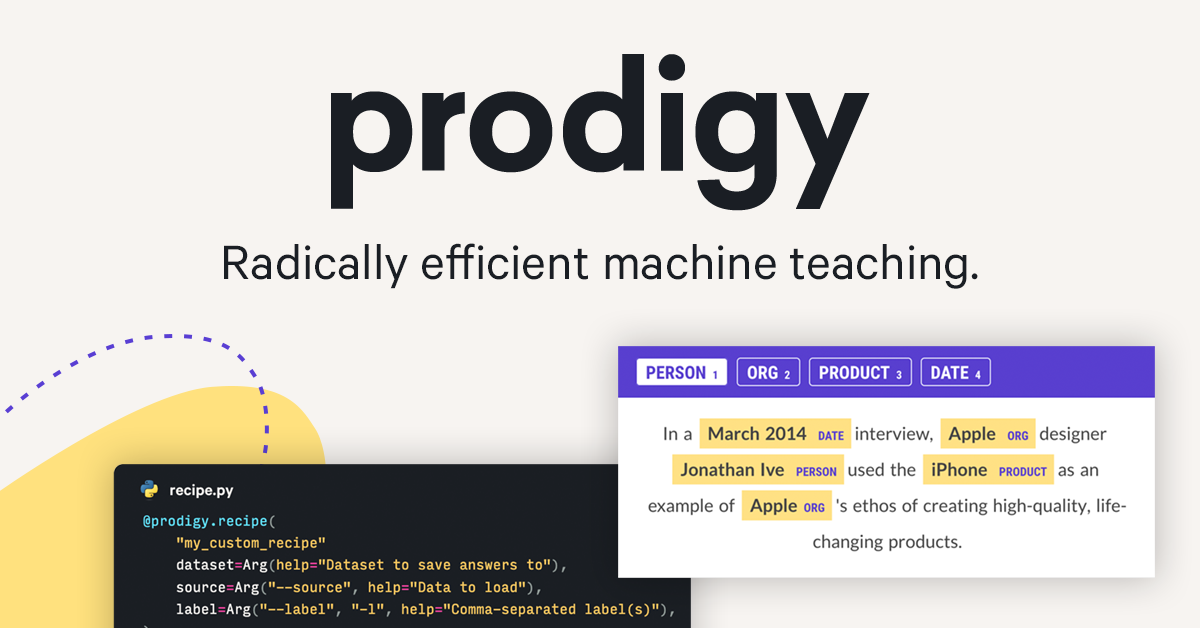
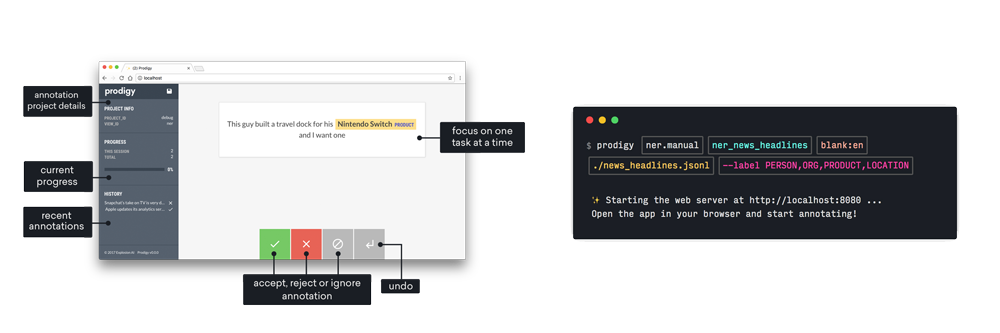
Prodigy is an extensible annotation tool that gives you a new way to build custom AI systems. Define your classification scheme with real-world examples rather than just prompts, and let powerful models assist – no machine learning experience required. Prodigy runs entirely under your control, making it suitable for even the strictest privacy requirements. You can download it and run it locally right out of the box, or adapt it to serve your infrastructure needs. The models you produce are yours as well, with absolutely no lock-in. Prodigy is a downloadable developer tool for creating training and evaluation data for machine learning models. You can use Prodigy to build custom AI systems specific to your use case that you can own and control. Prodigy is a Python package and library that includes a web application. You can customize Prodigy with your own Python functions, and mix and match frontend components to make your own annotation experience. Prodigy integrates tighly with spaCy, but can also be used with any other libraries and tools. The library includes a range of pre-built workflows and command-line commands for various common tasks, and components for implementing your own workflow scripts. Your scripts can specify how the data is loaded and saved and even define custom HTML and JavaScript. The web application is optimized for fast, intuitive and efficient annotation. Prodigy runs entirely on your own machines and never “phones home” or connects to our or any third-party servers. Once installed, you can even operate it on an entirely air-gapped machine without internet connection. All data and models you use and create stay entirely private and under your control. Prodigy allows for extensive customization. A range of built-in settings makes it easy for non-experts to customize the experience, and the developer API and SDK lets you integrate the tool into your existing workflows and build powerful extensions for custom use cases. At the core of Prodigy’s developer experience are recipes , Python functions that describe a workflow. Recipes can implement custom data processing and model training logic, integrate with third-party or internal libraries and tools and provide reusable workflows for your team that can be run without requiring programming or machine learning expertise. Prodigy also allows combining interfaces to build fully custom solutions, as well as implementing your own interactive interfaces with HTML, CSS and JavaScript. Prodigy is designed as a developer tool and assumes basic familiarity with the Python programming language and the command line. We also provide extensive documentation and examples to help you get started. Once you’ve set up an annotation task, the web application makes it easy for anyone to create annotations, no programming experience required. Prodigy is an extensible annotation tool that gives you a new way to build custom AI systems. Define your classification scheme with real-world example
Argilla
Prodigy
Argilla
Prodigy
Only in Prodigy (10)
Argilla

Prodigy
Argilla
Prodigy


