Bark
🔊 Text-Prompted Generative Audio Model. Contribute to suno-ai/bark development by creating an account on GitHub.
Bark is a transformer-based text-to-audio model created by Suno. Bark can generate highly realistic, multilingual speech as well as other audio - including music, background noise and simple sound effects. The model can also produce nonverbal communications like laughing, sighing and crying. To support the research community, we are providing access to pretrained model checkpoints, which are ready for inference and available for commercial use. Bark was developed for research purposes. It is not a conventional text-to-speech model but instead a fully generative text-to-audio model, which can deviate in unexpected ways from provided prompts. Suno does not take responsibility for any output generated. Use at your own risk, and please act responsibly. ©️ Bark is now licensed under the MIT License, meaning it's now available for commercial use! ⚡ 2x speed-up on GPU. 10x speed-up on CPU. We also added an option for a smaller version of Bark, which offers additional speed-up with the trade-off of slightly lower quality. 💬 Growing community support and access to new features here: 💾 You can now use Bark with GPUs that have low VRAM ( 4GB). Bark tries to match the tone, pitch, emotion and prosody of a given preset, but does not currently support custom voice cloning. The model also attempts to preserve music, ambient noise, etc. Bark is available in the 🤗 Transformers library from version 4.31.0 onwards, requiring minimal dependencies and additional packages. Steps to get started: Bark has been tested and works on both CPU and GPU (pytorch 2.0+, CUDA 11.7 and CUDA 12.0). On enterprise GPUs and PyTorch nightly, Bark can generate audio in roughly real-time. On older GPUs, default colab, or CPU, inference time might be significantly slower. For older GPUs or CPU you might want to consider using smaller models. Details can be found in out tutorial sections here. The full version of Bark requires around 12GB of VRAM to hold everything on GPU at the same time. To use a smaller version of the models, which should fit into 8GB VRAM, set the environment flag SUNO_USE_SMALL_MODELS=True. If you don't have hardware available or if you want to play with bigger versions of our models, you can also sign up for early access to our model playground here. Below is a list of some known non-speech sounds, but we are finding more every day. Please let us know if you find patterns that work particularly well on Discord! Bark is licensed under the MIT License. We’re developing a playground for our models, including Bark. If you are interested, you can sign up for early access here. 🔊 Text-Prompted Generative Audio Model There was an error while loading. Please reload this page. There was an error while loading. Please reload this page.
Rev AI
Rev AI, part of the Rev family, is a developer-first API that delivers industry-leading accuracy and fast performance at global scale. Click to learn
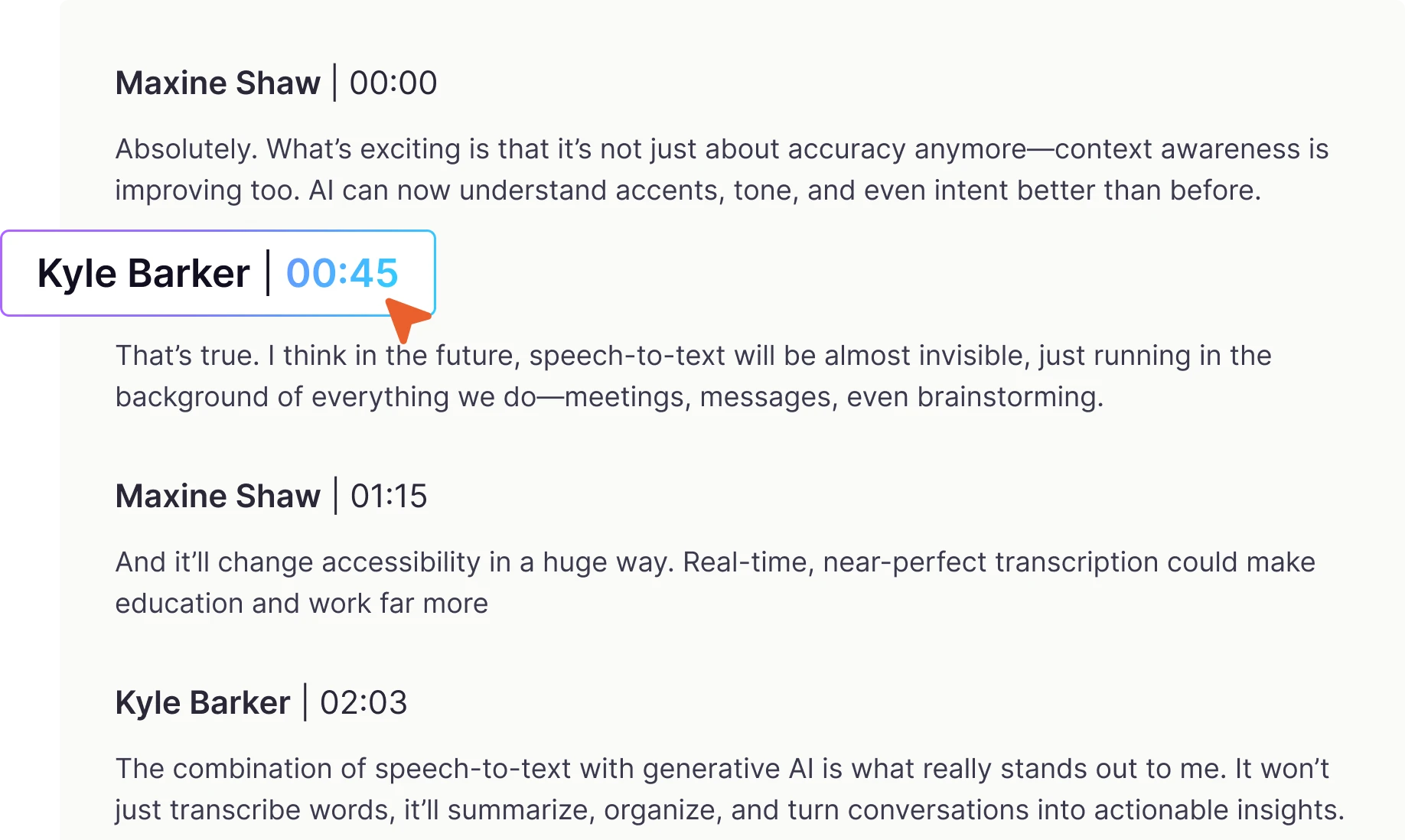
Get machine-generated transcripts in minutes from pre-recorded files or in real-time as audio streams. High accuracy across 57+ languages with proper grammar, punctuation, and formatting. Rev AI consistently outperforms competitors in accuracy for virtually every use case. Our proprietary models are trained using a carefully selected subset from a library of over 7M hours of human-verified speech data, giving us unmatched precision and adaptability. Get up and running in under an hour with our easy-to-use API, comprehensive SDKs, and expert support. Deploy in the cloud or on-prem. Go beyond transcription with language identification, sentiment analysis, topic extraction, summarization, and translation. Turn voice content into actionable intelligence. Handle sensitive data with confidence. SOC II, HIPAA, GDPR, and PCI compliant with 99.99% uptime. All files encrypted at rest and in transit. Enhance content searchability and analysis with precise word-level timestamps. Perfect for media applications, accessibility, and content indexing. Serve customers worldwide with 57+ languages and context-aware translations. Meet demand in new markets with consistently low WER. Find the right solution for you For press inquiries, email us at: press@rev.com Find the right solution for you For press inquiries, email us at: press@rev.com This short tutorial will teach you the basics of using the Asynchronous Speech-to-Text API. It demonstrates how to produce a transcript of an audio file submitted by you. This tutorial assumes that you have a Rev AI account. If not, sign up for a free account. The first step is to generate an access token, which will enable access to the Rev AI APIs. Follow these steps: The new access token will be generated and displayed on the screen. Save your access tokens somewhere safe; you will only be able to see them once. You are allowed a maximum of 2 access tokens at a time. Submit an audio file for transcription to Rev AI using the command below. Replace the REVAI_ACCESS_TOKEN placeholder with the access token obtained in Step 1, and replace the sample file URL shown below with the URL to your own audio file if required. You'll receive a response like this: You now need to wait for the job to complete. Wait for approximately 1 minute and then check the status of your job by querying the API as shown below: Polling the API periodically for job status is NOT recommended in a production server. Rather, use webhooks to asynchronously receive notifications once the transcription job completes. Here is an example of the output: Alternatively, you can get the plaintext version by running the command below:
Bark
Rev AI
Bark
Rev AI
Pricing found: $0.20, $0.10, $0.30, $0.005, $0.005
Rev AI (1)
Only in Bark (10)
Only in Rev AI (8)
Bark
No data yet
Rev AI
Bark
Rev AI
Bark
Rev AI


