
AI Gateway & LLM Observability
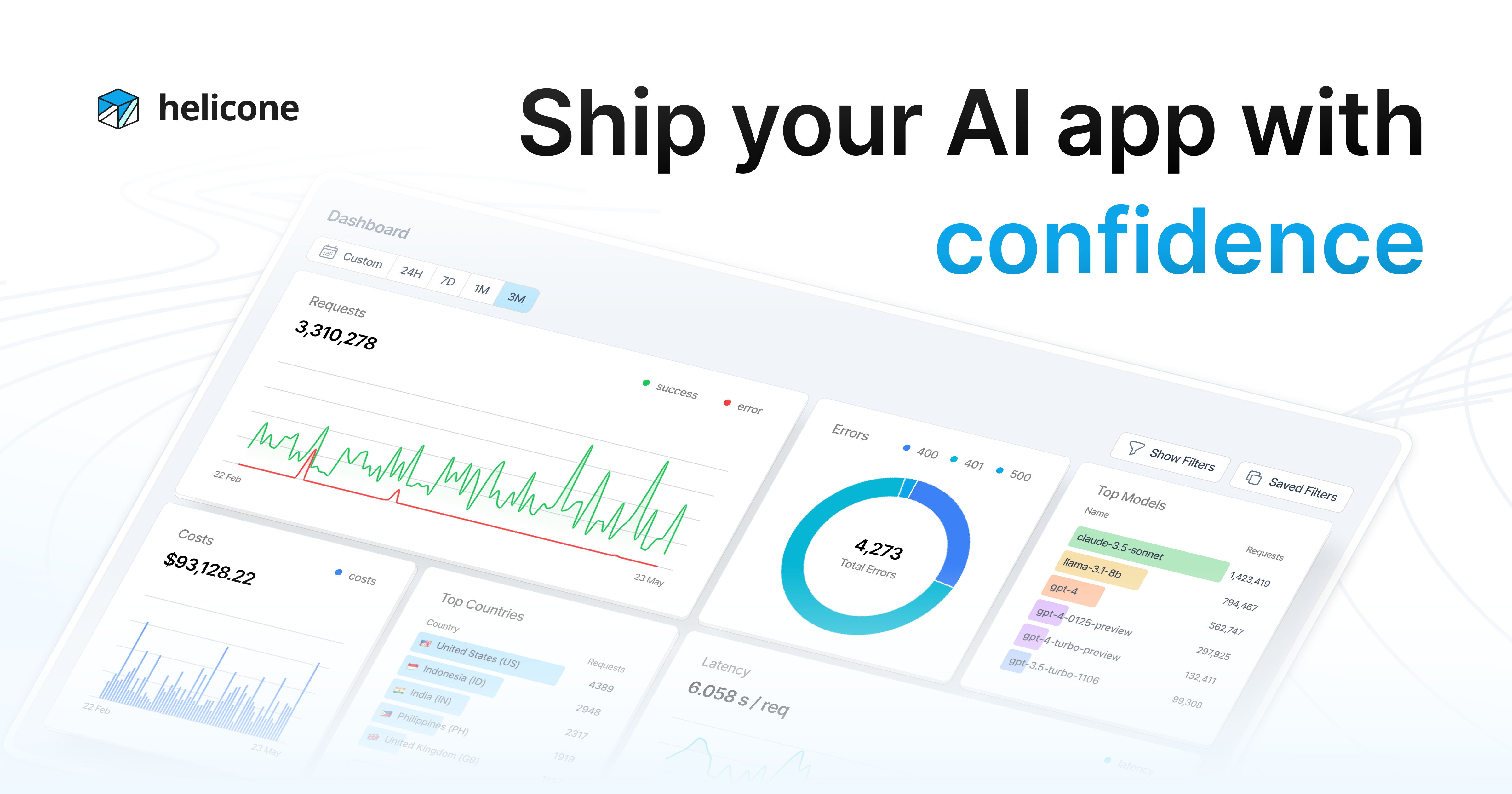
Helicone appears to be well-regarded, achieving positive ratings of 4/5 and 5/5 on G2, indicating user satisfaction with its functionality. Users highlight its integration within the domain of LLM (Large Language Model) tools, although it seems to have its own tracing format, which may add complexity in environments where standardization, like OpenTelemetry, is present. While pricing specifics are not detailed, the overall sentiment regarding value appears to be positive, given the high ratings. Helicone has a solid reputation, with notable mentions across multiple platforms, suggesting a strong presence and interest in its capabilities.
Mentions (30d)
0
Avg Rating
4.5
2 reviews
Platforms
3
GitHub Stars
5,406
501 forks


Helicone appears to be well-regarded, achieving positive ratings of 4/5 and 5/5 on G2, indicating user satisfaction with its functionality. Users highlight its integration within the domain of LLM (Large Language Model) tools, although it seems to have its own tracing format, which may add complexity in environments where standardization, like OpenTelemetry, is present. While pricing specifics are not detailed, the overall sentiment regarding value appears to be positive, given the high ratings. Helicone has a solid reputation, with notable mentions across multiple platforms, suggesting a strong presence and interest in its capabilities.
Features
Use Cases
Industry
information technology & services
Employees
3
Funding Stage
Merger / Acquisition
Total Funding
$0.1M
226
GitHub followers
21
GitHub repos
5,406
GitHub stars
20
npm packages
1
HuggingFace models
10
npm downloads/wk
2,159
PyPI downloads/mo
OpenTelemetry just standardized LLM tracing. Here's what it actually looks like in code.
Every LLM tool invents its own tracing format. Langfuse has one. Helicone has one. Arize has one. If...
View originalPricing found: $79, $799, $5, $100
g2
What do you like best about Helicone?It's actually a great Open-source and cheap Platform for tracking different LLM usage, and can also create alerts on LLM responses. It supports multiple LLMs, including open-source ones. You'll get 100,000 free token uses. It's easy to implement and also offers great customer support. I use it more to integrate it into my projects. Review collected by and hosted on G2.com.What do you dislike about Helicone?The issue is that there are numerous alternatives, and implementing a custom LLM proxy on a framework like Axflow is challenging. The Experiment features are yet to be introduced, so we'll have to wait and see how go it is. Review collected by and hosted on G2.com.
What do you like best about Helicone?Track usage, costs, and latency metrics with one line of codes. Review collected by and hosted on G2.com.What do you dislike about Helicone?How long it takes to scan the computer while doing the upload. Review collected by and hosted on G2.com.
Made an awesome-list for everything LLM cost, would love contributions
So a few months back I got surprised by my Anthropic bill which somehow racked up like $400 ish on a staging key in a few weeks just running evals, no budget cap pretty dumb in hindsight I mean it’s not a big cost but I should have been careful nonetheless After that I started keeping a notes file of tools that actually helped reduce cost stuff like token counters, pricing pages that update properly, caching layers, prompt compression libs, observability tools (helicone, langfuse, langsmith, etc) it slowly grew to 80–90 entries so I cleaned it up and put it on github: [https://github.com/ankitvirdi4/awesome-llm-cost](https://github.com/ankitvirdi4/awesome-llm-cost) what’s in there right now: pricing calculators + token counters observability / tracing (helicone, langfuse, langsmith, openllmetry, phoenix) caching (gptcache, semantic caching approaches) model routers (openrouter, notdiamond, portkey) prompt compression + context window stuff eval cost tracking self hosting / GPU cost calculators everything is linted (awesome-lint), short descriptions for each entry, and I checked links recently so nothing should be dead if there’s anything you’ve used that saved you money on inference, drop it here or send a PR especially looking for more prompt compression stuff, that section feels kinda weak rn not affiliated with anything listed btw just got tired of having 80 bookmarks
View originalAfter 6 months of running AI agents in production I think the framework you pick barely matters. The thing that kills them is something else.
Going to get downvoted for this but here we go. I've been running about 30 agents in production for paying customers for the last 6 months and I'm convinced the framework debate is mostly a distraction. LangChain, CrewAI, AutoGen, OpenAI Agents SDK. Pick whichever one your team already knows. It doesn't matter as much as you think. What actually decides whether your agent works in production is something almost nobody talks about on this sub, and it isn't in the framework. Here's what I've seen kill more agents than every framework bug combined. The agent gets stuck in a loop. It calls the same tool 200 times in 4 minutes because something downstream returned ambiguous data and the LLM decided to retry forever. Your OpenAI bill goes from $3 a day to $400 in one afternoon. By the time you notice you've burned a grand. You can't even tell which agent did it because there's no audit trail. Your VPS reboots overnight for kernel patches. Every agent that was mid-task loses everything. Tomorrow morning the support agent has no memory of yesterday's tickets, the research crew has forgotten what they were investigating, the pipeline agent restarts from scratch. None of these are framework problems. They're memory and state problems. A customer complains the agent gave them wrong info three days ago. You go to debug. There's no record of what the agent saw, what it decided, or which tool calls it made. The framework didn't log that because frameworks aren't observability tools. You shrug and refund. You scaled to 15 agents working together. Two of them have conflicting beliefs about the same customer because their memory isn't shared. The customer gets two different answers in the same conversation depending on which agent replies first. You've been around enough times to realize the part you actually need isn't in the framework at all. What I think the real stack is. The framework just orchestrates LLM calls. Use whatever your team likes. It's the cheap layer. A persistent memory layer that survives crashes, restarts, and redeploys, so the agent has actual continuity. This is the layer that decides whether your agent is a toy or a product. Loop detection at the runtime layer, not bolted on as a wrapper around the framework. Something that catches your agent making the same call too many times in a row and stops it before the bill explodes. An audit trail of every decision the agent made, with a hash chain so you can prove later what happened when the customer pushes back. Screenshots and logs aren't enough when ten thousand dollars is on the line. Shared memory between agents in the same team so they're not having different conversations about the same customer. Cost tracking per agent so you actually know which one ran away with your budget. When I look at what makes the agents that survive production look different from the ones that died, it's never that they picked the right framework. It's that they had this layer underneath, either built carefully in-house or borrowed from somewhere. Full disclosure I'm building one of these tools. There are others. Mem0 and Zep and Letta in the memory space. Helicone and LangSmith in the observability space. Mix and match. Use one or build your own. Just please stop arguing about whether LangChain or CrewAI is better when the thing eating your production agents has nothing to do with either of them. What's been your worst production agent failure? Curious what other people have actually hit. I built a free tool that aims to solve most of this issue, what do you think?
View originalHow are people actually tracking OpenAI costs in production?
Curious what this community actually uses for OpenAI cost monitoring on real production apps. There are a lot of "I got a $X surprise bill" posts here, but I rarely see the follow-up: what tooling did people land on after the wake-up call? For those running OpenAI in production: \- Real-time tracking or just checking the billing dashboard monthly? \- Rolling your own or using a tool (Helicone, Langfuse, etc.)? \- Breaking costs down per user / per feature, or just looking at the total? Asking because I'm building in this space and trying to figure out what people actually do vs. what they say they should do.
View originalAgentic Workflow Visualization and API Gateway
I am building an API gateway for agents that can make your agentic AI code model and provider agnostic. I am also grouping agent runs that show multiple llm calls and tool calls in the visualization piece. It gives details on tokens, cost and model latency. I am doing this without requiring any instrumentation in the agentic code. The agents (python for now) are started by a rust correlator that assigns a job\_id to each agent so we could track api and tool (inferred from http requests and responses) calls across the entire agentic run. The servers are also in rust. I also have an implementation where instead of the rust correlator i have python and other platform shims that do the same job and the servers are in go. I would appreciate comments from people who are in AI ops who use tools like litellm and Helicone and can provide feedback or complicated use cases. I plan to make everything open source so looking for collaborators too.
View originalOpenTelemetry just standardized LLM tracing. Here's what it actually looks like in code.
Every LLM tool invents its own tracing format. Langfuse has one. Helicone has one. Arize has one. If...
View originalRepository Audit Available
Deep analysis of Helicone/helicone — architecture, costs, security, dependencies & more
Yes, Helicone offers a free tier. Pricing found: $79, $799, $5, $100
Helicone has an average rating of 4.5 out of 5 stars based on 2 reviews from G2, Capterra, and TrustRadius.
Key features include: Soohoon Choi.
Helicone is commonly used for: Monitoring LLM performance, Tracing API calls in real-time, Cost estimation for AI projects, Educational projects for students, Startup funding management, Open-source project contributions.
Helicone integrates with: OpenAI, AWS Lambda, Slack, Google Cloud Platform, Microsoft Azure, Kubernetes, Docker, Jupyter Notebooks, Prometheus, Grafana.
Helicone has a public GitHub repository with 5,406 stars.
Based on user reviews and social mentions, the most common pain points are: cost tracking, anthropic bill, openai bill, surprise bill.
