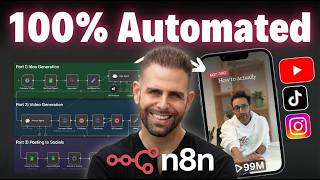
n8n is a workflow automation platform that uniquely combines AI capabilities with business process automation, giving technical teams the flexibility
n8n consistently receives high ratings in reviews, appreciated for its flexibility and ease of building automation workflows. While some users express frustration with setup complexities, the overall reception is positive, with many praising its open-source nature. Pricing sentiment appears favorable as n8n is often seen as a cost-effective alternative to competitors like Zapier. Overall, the platform enjoys a solid reputation among users who value customizable and efficient automation solutions.
Mentions (30d)
13
2 this week
Avg Rating
4.8
20 reviews
Platforms
2
Sentiment
29%
18 positive


n8n consistently receives high ratings in reviews, appreciated for its flexibility and ease of building automation workflows. While some users express frustration with setup complexities, the overall reception is positive, with many praising its open-source nature. Pricing sentiment appears favorable as n8n is often seen as a cost-effective alternative to competitors like Zapier. Overall, the platform enjoys a solid reputation among users who value customizable and efficient automation solutions.
Features
Use Cases
Industry
information technology & services
Employees
880
Funding Stage
Series C
Total Funding
$254.0M
20
npm packages
5
HuggingFace models
g2
What do you like best about n8n?The power it gave me to build AI workflows when other tools had limitations. Self hosting the community edition is a big + for my solo projects. There is a big of a learning curve but it is actually healthy as it helped me learn concepts like JSON, javascript, to really understand how integrations work Review collected by and hosted on G2.com.What do you dislike about n8n?So there are a couple of things that could be improved. For the AI integrations, we still aren't able to fully customize the settings of the AI models that we use. For example, GPT-5 has been released quite a while ago with new parameters like minimal reasoning or verbose, which are elements we still cannot edit when using OpenAI as a chat model. I must say that the cloud instances have very limited power and crash a lot when processing lots of data. Review collected by and hosted on G2.com.
What do you like best about n8n?It has a completely easy-to-use interface, and it’s very expandable. Review collected by and hosted on G2.com.What do you dislike about n8n?So far, I don’t have any dislikes about n8n. Review collected by and hosted on G2.com.
What do you like best about n8n?What I like most about n8n is that it gives me the power of a low-code tool without boxing me in. The visual workflow builder is easy to pick up, so getting my first automations live didn’t take long. At the same time, it still lets me build fairly complex logic when I need it. Once a workflow is set up, it just runs in the background and stays out of the way, which means it’s something I actually use regularly instead of only testing once and then forgetting about it. I also appreciate how many features and integrations are available out of the box. Connecting different tools is usually straightforward, and when something isn’t supported directly, calling custom APIs is still simple enough to do. The documentation and community support have been helpful as well, especially when I’m trying to tackle something a bit more advanced. Overall, n8n hits a sweet spot between ease of use, flexibility, and straightforward implementation and integration—something I haven’t really found in other automation platforms. Review collected by and hosted on G2.com.What do you dislike about n8n?I wouldn’t say I “dislike” n8n, but it does have a few rough edges. The learning curve can feel pretty steep at the beginning, especially if you’re not already comfortable with APIs or other automation tools. Some nodes and error messages come across as quite technical, so getting more complex workflows to run exactly the way you want can take some trial and error. Overall, performance and stability are solid, but I do occasionally run into small bugs or editor quirks that break my momentum. The documentation has improved a lot, which I appreciate, yet there are still times when I wish it included more real-world examples or clearer guidance for advanced use cases. None of this is a deal-breaker for me, but these are the main areas where I think n8n still has room to grow. Review collected by and hosted on G2.com.
What do you like best about n8n?The UI and UX are easy to understand. n8n is also an easy tool to use for automation, and it feels straightforward to get started with. Review collected by and hosted on G2.com.What do you dislike about n8n?From my side, there isn’t much to dislike about n8n. Review collected by and hosted on G2.com.
What do you like best about n8n?I like the advancement of n8n and its integrations. Review collected by and hosted on G2.com.What do you dislike about n8n?Sometimes it is very complicated to use if you do not have basic development knowledge or if you do not rely on the use of advanced AI like Claude Code. Review collected by and hosted on G2.com.
What do you like best about n8n?This tool changed everything for me and gave me full visibility on LinkedIn. It also helped me build and automate so many things across LinkedIn and other tools. Review collected by and hosted on G2.com.What do you dislike about n8n?For me, as a local host user, I couldn’t use MCP. Review collected by and hosted on G2.com.
What do you like best about n8n?n8n lets you connect apps, APIs, databases, and AI models into automated workflows using a visual node-based editor. Each node represents a step like triggering events, transforming data, or calling APIs.Unlike many tools, n8n doesn’t limit complex workflows or charge per step. This is why many AI engineers and companies prefer n8n. Review collected by and hosted on G2.com.What do you dislike about n8n?n8n has a steeper learning curve compared to tools like Zapier, workflows can become complex and harder to debug as they grow, self-hosting requires ongoing maintenance and infrastructure management, and some integrations are less polished or community-maintained. Review collected by and hosted on G2.com.
What do you like best about n8n?Having a database of templates to start working from Review collected by and hosted on G2.com.What do you dislike about n8n?Lack of explanation on what might have gone wrong Review collected by and hosted on G2.com.
What do you like best about n8n?The ability to be able to learn the tool Review collected by and hosted on G2.com.What do you dislike about n8n?It's uncomfortable to host locally, not impossible. Review collected by and hosted on G2.com.
What do you like best about n8n?easy workflow automation, visual drag-and-drop builder, flexible integrations, supports custom code when needed, open-source and self-hostable, good for connecting multiple tools Review collected by and hosted on G2.com.What do you dislike about n8n?UI can feel less polished, debugging workflows can be tricky, limited native integrations compared to larger platforms, performance can lag on complex flows, documentation gaps in some areas Review collected by and hosted on G2.com.
I built an AI-native Business OS using Claude, Obsidian, and n8n
I built an AI-native Business OS using Claude + Obsidian + n8n and it’s changed the way I operate completely. The interesting part isn’t really the AI itself. It’s the architecture around it. Claude became dramatically more useful once I stopped treating it like a chatbot and started treating it like an intelligence layer connected to structured context. Current setup: - Obsidian stores operational memory - Claude handles contextual reasoning/writing - n8n orchestrates workflows + triggers Some things the system now does automatically: - generates morning briefings before I wake up, - prepares pre-call client summaries, - surfaces open issues/followups, - drafts content from rough notes, - and keeps operational context persistent across projects. One thing I’ve learned building this: AI becomes exponentially more useful when paired with: - structured memory, - clean workflows, - and consistent operational context. Otherwise every conversation starts from zero again. I also try to keep the system grounded pretty heavily: - outputs are treated as drafts/briefings, - important decisions always get human review, - and most workflows are retrieval/context based rather than open-ended generation. The goal isn’t replacing thinking. The goal is reducing operational clutter so more deliberate thinking can happen. Curious if anyone else here is building similar “AI operating system” style workflows around Claude. submitted by /u/liberal_bhakt [link] [comments]
View original[Virtual] AI Saturdays - Workflow Automation with AI (23rd May, 6 PM ET)
Hosting this Saturday's AI Saturdays session on workflow automation with AI. The idea: most jobs have recurring tasks that look the same every week. Read the email, pull out the key info, log it somewhere, send a follow-up. Tools like n8n and Make let you chain AI into those flows so the work runs on its own. We'll look at how the pieces fit together with AI. Link: https://www.meetup.com/chillnskill/events/314617067/ submitted by /u/Competitive_Risk_977 [link] [comments]
View originalBest way to use Claude daily — Web app vs Claude Code (VS Code) vs API? What's your setup?
I've been using Claude through the web app but I'm wondering if I'm leaving value on the table. I've heard people talk about: Claude.ai (web app) — the default Claude Code — the CLI/VS Code integration Direct API — full control, build your own setup What's the real difference in your day-to-day use? Is Claude Code worth switching to if you're not a developer? What can you do with one that you can't do with the others? Currently using Claude mainly for workflow automation (n8n), writing, and research. submitted by /u/Gullible_Wrangler_53 [link] [comments]
View originalNeed to connect Docsend to Claude
Been able to automate a good chunk of my work with claude, N8N etc but there have been a couple that I have just not been able to crack. So my background isnt technical so been able to do these things so far by watching videos or simply asking an ai tool. Currently, I am stuck on trying to integrate docsend into claude so it runs a simple flow: I was thinking sending / uploading a pdf into a form, it uploads it to docsend and sends me by slack, mail etc a viewable link so I can share. Would appreciate any feedback on how as I am stuck (couldnt get docsend's API and MCP) Thank you in advance submitted by /u/Electrical_Editor880 [link] [comments]
View originalHelp passing data between two Claudes
I'm having trouble and Claude wasn't much help. I use Claude Desktop, and have a work Claude account (provided by/paid for by work) and a personal Claude account. They must remain separate, and they are installed on different machines. HOWEVER, I would like for Personal Claude to have *some* level of insight into what Work Claude is helping me with. Not all the details, just the high level, so it has context. If you've seen Severance, I'm trying to build a bridge between my Innie and my Outie. I was able to write a skill for my Work Claude, that I can initiate in any session, to have it store pertinent details. Then, I wanted to set up a scheduled task for both Work and Personal. Work to write a brief and store it ... somewhere ... and then Personal to read that brief and ingest. My first thought was a Google Doc. Clean and easy, except that the Google Drive/Docs MCP apparently doesn't support write functionality. I explored using webhooks and n8n, but that was a cluster as well. Finally settled on Notion, and it works, but it's messy because I don't use Notion for literally anything else, and based on my light research, I don't really have any other need for it outside of this. I'm also trying to get setup with Obsidian and figure out how to use that to keep myself more organized. That would actually be a perfect use-case for this document to pass things from Work to Personal, except for the whole local-storage thing. Any other suggestions? I dislike having a single-use tool like Notion in the middle. The key limitation is that this is a fully automated effort, using Scheduled Actions in Claude Cowork. EDIT: I appreciate the concern and watch-outs. These are things that I had already considered, which is why I built a specific skill to generate these, and included a HITL review point, as well. The skill helps to specify that I am *not* looking for details or any protected business information. I'm specifically looking for notes, comments, and insights about how I work, how I make decisions (or avoid them), and other observations about who I am at work, which is somewhat different than how I manage things in my personal life. The output and information that I'm sharing is something I would be absolutely comfortable sharing with my boss or our CEO/CTO. submitted by /u/DruVatier [link] [comments]
View originalGsc, ga4, gads + claude code
Witam wszystkich, szukam pomysłów i workflow jak to wszystko spiąć. Zastanawiam się nad n8n do generowania raportów co tydzień/miesiąc i podpięcie claude za pomocą MCP do bierzecych pytań. Dodatkowo chce spiąć claude z WP i Woo do wprowadzania zmian na produktach itp. czy ktoś z was robił coś takiego i może podzielić się doświadczeniem, jakie problemy napotkał itp? Bazę wiedzy mam w obsydian i chciałbym tam mieć analizy a raporty w jakimś csv np na Google driver. Jeżeli źle myślę proszę o porady. Z góry dzięki submitted by /u/Icy_Froyo_8027 [link] [comments]
View originalN8N
Anyone actively using this? Trying to learn it for work doing some classes on it got a pretty good handle but I don’t need to bug my IT guy every other day about nuances. Advice? Also this shit super fun. submitted by /u/K_Tronica [link] [comments]
View originalLeveraging Claude Pro to N8N automation
Hello Good day everyone! I would like to ask some tips of how to leverage on subscribed Claude Pro to help learn N8n Workflow Automation. I wanna learn the in depth of it like how to handled errors and stuff, I know that Claude Code can automatically create Workflow from me but I want my knowledge to be in depth so I can Monetize it. submitted by /u/Relative_Capital_610 [link] [comments]
View originalClaude code on E-commerce Brand
Recently, I built a swarm of AI agents to replace our customer service representatives and I hosted it on n8n. I also built an automation to give us a daily report. All these was built from Claude, I wonder what else can I build to help push our company forward? Any tips or recommendations? submitted by /u/Direct-Football7180 [link] [comments]
View originalI got sick of rebuilding the same ad research pipeline for every new client so I built something that just handles it
I got sick of reconfiguring a new stack of tools every time I took on a new app client. The workflow was always the same. Open Ad Library, find what's running, screenshot the good stuff, set up Apify, connect Airtable, wire up the pipeline, brief an editor, wait a week. Then do it all again for the next client. Tried building my own pipeline. Claude Code, Apify, Airtable, Whisper, n8n. Spent more time maintaining the infrastructure than actually running ads. So I built Zura instead. Paste any Meta Ad Library URL. It analyzes the winning creative and generates launch-ready video variations. No pipeline. No setup per client. No tooling to maintain. The time between "found a winner" and "launched a test" went from days to minutes. zura.today submitted by /u/Natural-Ad7262 [link] [comments]
View originalEasiest method for social media post automations?
hello, im not a dev or too technical, marketing bg, trying to automate in the easiest way possible.. we already use a scheduler (content studio) and was hoping to automate it with claude cowork/desktop or n8n whatever is easiest to setup and run. the goal is to have our system placed, integrate some core features/topics that should be the content inspiration for every week, repeated.. and adapted to each different platform.. any direction would be appreciated submitted by /u/AdamScot_t [link] [comments]
View originalWe’re hosting the biggest Claude Code Prompt-a-thon at the AI x Marketing Summit in SF.
We’re hosting the biggest Claude Code Prompt-a-thon at the AI x Marketing Summit in SF on May 28–29. For 36 hours, you’ll actually build with AI: • Claude Code • Humanic • n8n • MCPs • Figma Make • AI workflows for SEO, ads, lifecycle, outbound, content, and growth You’ll work alongside marketers and operators building real-world AI systems — not just talking about them. The summit includes hands-on workshops, promptathons, networking with AI-native marketers, and sessions from founders, CMOs, and operators shaping the future of marketing. Bring your team to SF. Compete, build, and walk away with top-tier tech. The full agenda is now live — grab your ticket now. Learn more: https://aixmarketingsummit.com/ submitted by /u/Brilliant_Sector_427 [link] [comments]
View originalBuilt a Claude Code plugin for GDPR/DSGVO audits because attorney reviews were eating my budget
Quick Background: Developing a B2B SaaS for German businesses (KSKlar, a tax compliance product). Pre-launch, each cookie banner question, each DPA, each privacy policy draft went to the attorney. Each iteration took 300-500 EUR and 2-3 weeks. Most of those iterations didn't involve any difficult legal questions. They were about making sure basic things were done - no Google Fonts requests before consent, no § 5 TMG (it got changed to § 5 DDG in 2024, neat little trick), documented AVV with Mistral, etc. So I built it into a Claude Code plugin. It scans a codebase, flags issues, provides clear replacements, cross-checks citations from eur-lex or gesetze-im-internet. Then I give it to the attorney instead of sending a GitHub repository link. Saves her about 70% of time, saves me even more money. Six weeks trimming everything down to what was generalizable, another two weeks scrubbing it for open-sourcing. Released it to GitHub this morning. Tech Stack: Slash commands for auditing codebase, live URL, single document (privacy policy draft, DPA, etc.), looking up KB, etc. Three custom agents on Opus 4.7 1M model (wrong case number outputs with smaller models is an actual issue) 63 KB files with primary source links (eur-lex, rechtsprechung-im-internet, curia, BfDI, EDPB, state DPAs) Context loading through hooks (so KB doesn't clutter your session, ~1k token overhead initially, loads dynamically through regex triggers) Scope is limited to Germany/EU - GDPR/DSGVO, BDSG, TDDDG, UWG, AI Act, UrhG, the whole thing. Nothing for US/UK/CH since the paragraph references and case laws are different. Trying to build multiple jurisdiction support into one plugin ends up being poor for all of them. Limitations I want to be clear about: This isn't legal advice. Disclaimer at the start of each output. Still need a real attorney for production, just not as much of them. Plugin reduces cost of attorney work. KB will always be as updated as I can manage (verified May 08, 2026, in 63 files). Legal climate changes - the KB can be refreshed using the /legal-audit-de-update command. Refreshes automatically from primary sources every 90 days. Content in German remains in German (paragraph wording is legally binding in the original language, translating would make it less useful for actual attorneys). Wiki provides parallel English documentation for German-based development teams working in English. Installation: /plugin marketplace add FutureRootsDE/legal-audit-de /plugin install legal-audit-de@futureroots-legal MIT License. Repository: github.com/FutureRootsDE/legal-audit-de For those developing products that touch EU users and don't have their own legal team, I'd love to know what else they should consider. Particularly interested in mobile apps and API-only services. Have checklists for SaaS, landing pages, e-commerce, n8n, content, but those two have gaps. submitted by /u/PrudentStop5612 [link] [comments]
View originalCowork keeps using browser for API calls
My cowork keeps using the browser for API calls. I asked why and got the following response: The bash sandbox is behind a restrictive proxy that blocks external connections (you can see X-Proxy-Error: blocked-by-allowlist in the response). So curl from the sandbox can't reach n8n directly. The browser works because it runs in your actual Chrome session, not the sandboxed environment. It's an infrastructure limitation, not a choice I made. For the n8n MCP tools, those work for executing workflows but not for updating workflow JSON. So the browser is still the only way to do workflow CRUD against your self-hosted n8n. Is there not a way for cowork to do API calls without the browser? Can I give it any suggestion or skill for that? submitted by /u/nano-zan [link] [comments]
View originalHow do you create n8n workflows with cowork?
Hey there, How can I have cowork create n8n workflows. I thought the MCP could do that, but cowork just explained the following: The connected n8n MCP only exposes three tools: search_workflows, get_workflow_details, and execute_workflow. So viewing and parameterized execution already work — but creating or editing workflows is not possible through the MCP. I checked the registry; there's no richer n8n connector available there. Any tips or good practices? submitted by /u/nano-zan [link] [comments]
View originalRepository Audit Available
Deep analysis of n8n-io/n8n — architecture, costs, security, dependencies & more
n8n uses a subscription + tiered pricing model. Visit their website for current pricing details.
n8n has an average rating of 4.8 out of 5 stars based on 20 reviews from G2, Capterra, and TrustRadius.
Key features include: Fully on-prem option, SSO SAML and LDAP support, Encrypted secret stores, Version control, RBAC permissions, Audit logs and log streaming to SIEM, Workflow history, Real-time alerts.
n8n is commonly used for: Automating scheduled workflows, Webhook-based event handling, Chatbot integrations, Data processing and transformation, Real-time alerting and monitoring, Collaboration in teams with 100+ employees.
n8n integrates with: Claude Code, Slack, Google Sheets, Trello, GitHub, Zapier, Salesforce, AWS, Microsoft Teams, Discord.
n8n Livestream: AI Product Updates, Firecrawl & the latest Community Challenge
Mar 26, 2026
Based on 63 social mentions analyzed, 29% of sentiment is positive, 70% neutral, and 2% negative.