
SpaceKnow provides global coverage of the earth through cutting edge technology giving you access to view specific locations and monitor trends in our
SpaceKnow is praised for its innovative use of satellite data to provide insights across various industries, notably in economic activity monitoring, environmental assessments, and global market analysis. The social mentions highlight its diverse applications, like methane emissions monitoring and economic forecasting in different countries. However, there are no explicit reviews mentioned in the data provided, so complaints and user pricing sentiment towards SpaceKnow are not accessible. Overall, SpaceKnow boasts a positive reputation, underscored by frequent mentions in high-profile media and continuous engagements with their innovative satellite-driven projects.
Mentions (30d)
16
Reviews
0
Platforms
3
Sentiment
12%
16 positive


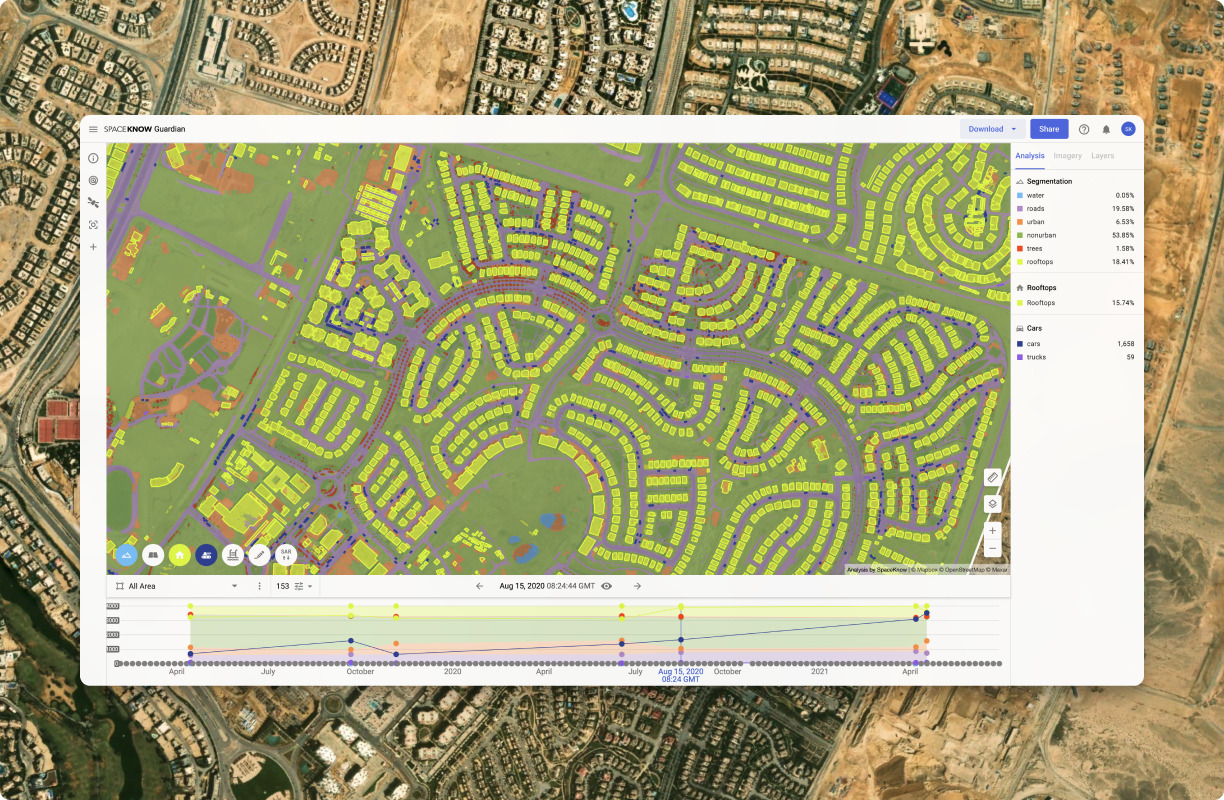
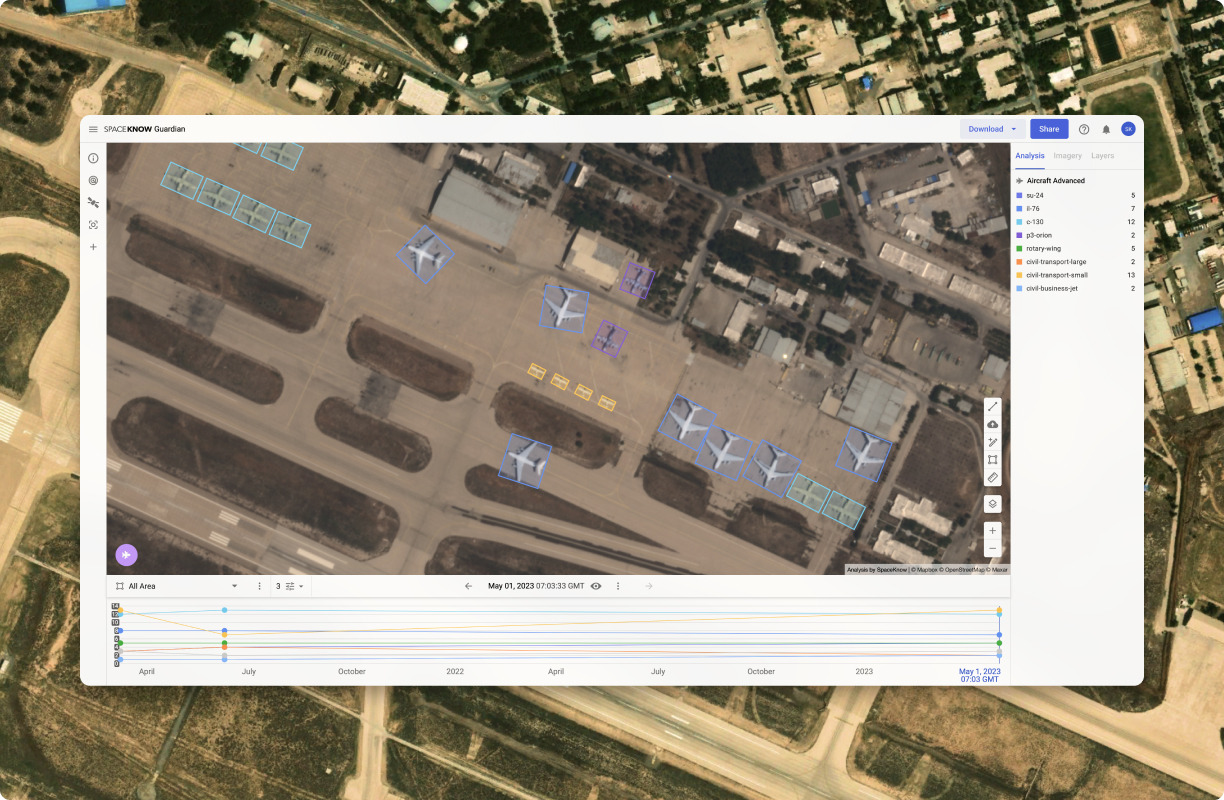
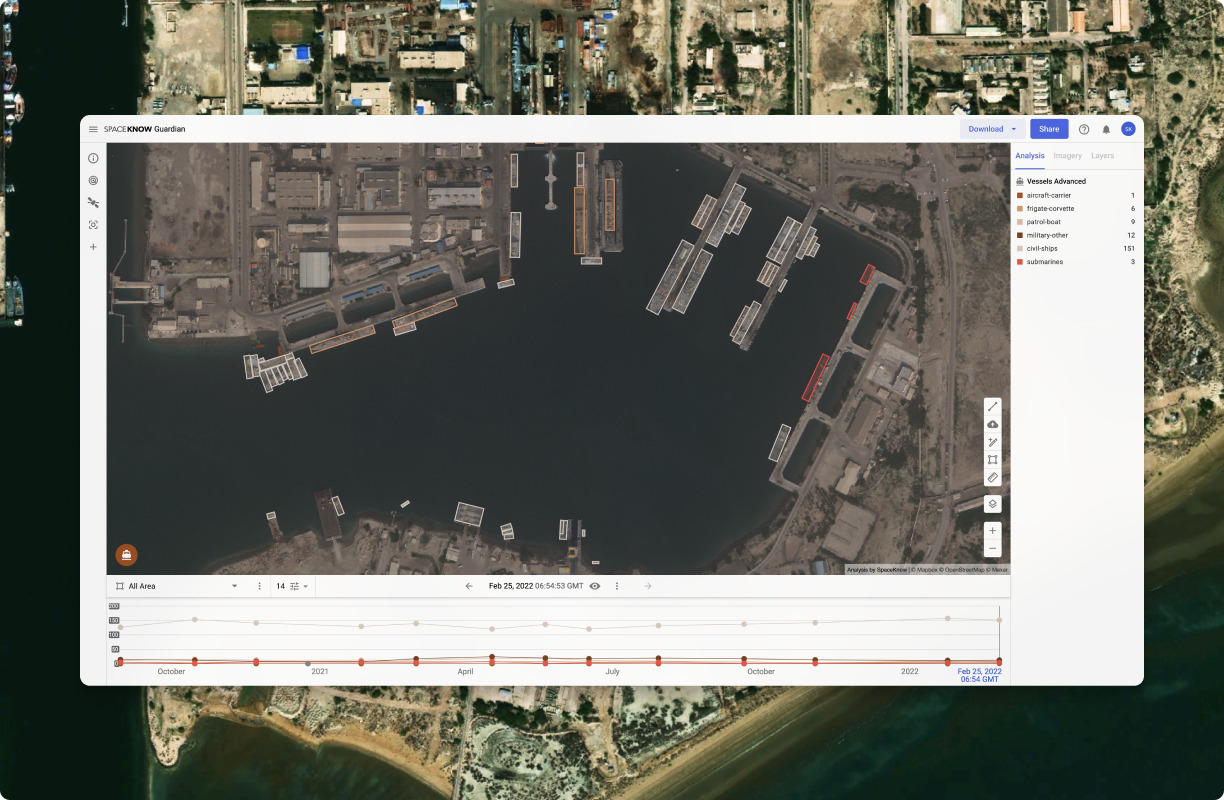
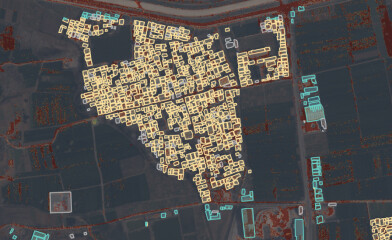
SpaceKnow is praised for its innovative use of satellite data to provide insights across various industries, notably in economic activity monitoring, environmental assessments, and global market analysis. The social mentions highlight its diverse applications, like methane emissions monitoring and economic forecasting in different countries. However, there are no explicit reviews mentioned in the data provided, so complaints and user pricing sentiment towards SpaceKnow are not accessible. Overall, SpaceKnow boasts a positive reputation, underscored by frequent mentions in high-profile media and continuous engagements with their innovative satellite-driven projects.
Features
Use Cases
Industry
information technology & services
Employees
37
Funding Stage
Series A
Total Funding
$9.2M
🚀 Exciting News! 📰 @Bloomberg featured SpaceKnow's 🛰️ data. Discover how we're revolutionizing industries with our innovative technology. Read the full article now! 🛰️🌍 #SpaceKnow #altdata #sate
🚀 Exciting News! 📰 @Bloomberg featured SpaceKnow's 🛰️ data. Discover how we're revolutionizing industries with our innovative technology. Read the full article now! 🛰️🌍 #SpaceKnow #altdata #satellitedata #China #MacroMonday https://t.co/q9aEHN2KEb
View originalBest practices & custom skills for getting high-quality Flutter UI/UX output from Claude Code?
Hi everyone, I am planning to build a mobile app using Flutter, and I want to leverage Claude Code as my primary development partner. My main focus is achieving a highly polished, high-quality front-end UI/UX. As we know, LLMs can sometimes generate clunky layouts, poor spacing, or messy widget trees if not guided properly. I want to avoid the "prototype look" and build something production-ready. For those who have experience building Flutter apps with Claude Code: What are the best prompt strategies or workflow constraints you use to enforce strict UI design systems (typography, padding, theme consistency)? Are there any specific custom Agent Skills, custom system prompts, or MCP tools you recommend loading into the session to improve UI precision (e.g., Stitch, Figma) Would love to hear your workflows, tips, or specific skills that helped you step up your front-end game with Claude Code. Thanks! submitted by /u/Sensitive_Drink_4050 [link] [comments]
View originalWhy We Build
One silver-lining to the dead internet we're living in, today, is that it's very quickly teaching us that we can't rely on our senses as much as we believe we can. It's not healthy to always live in skepticism, but it is necessary in a World where you don't know what's up or down anymore. That's why we need great minds to focus their attention on solving the problems associated with credible information sharing without it becoming some centralized playground designed to look like the free-flowing exchange of ideas. If we don't solve for that, then I guess we're heading into a future that a small handful of people want because elections or public opinion will no longer matter. One of the biggest focuses in AI should be in figuring out how to get it to provide deep credible knowledge in specific domains that can be best applied to the problems we're trying to solve. Sure, it can do this with enough fenagling, but what I really mean is having something easy for everyone to use like Perplexity or Gemini, only it doesn't simply find consensus information from the internet using all these black box methods that are owned by major corporations. Instead, it should use direct knowledge from domain experts who structure and cite their material and as users, we should be able to backtrack all of it, including the original author. And all of this should be achievable by simply engaging with a chatbot agent that can reliably go out and help me discover all of these things. Also, we shouldn't have to simply trust that the application works. We should be able to go in and see exactly how it's working. This way, the public can audit the systems we're relying on for grounding our worldviews. That, to me, is where we should be if we really want to break from the chains of propaganda and reclaim our genuine thoughts about how we ought to live. The alternative independent media space was co-opted long ago and now all of the feeds keep us in a state of perpetual dislocation from our friends, family, communities, new solutions, and better approximations to the truth. We exist in a walled-off digital pasture. But if regular people who are smart and capable enough decide to leverage this new technology, then we can break through the fencing and finally live in a world where discovery-based researching and learning can be easier than Google, which could eventually individuate society again, like how it was before, instead of keeping us clustered into specific groups based on our viewing preferences. That's why my brother and I got into this business. Yeah, sure, we also wanna make a buck so we can retire with dignity. That's true. But the drive has always stemmed from wanting to figure out a better way for people to share hidden insights and create things that are bigger than they thought they could handle. We have a long way to go, but we're making the first small steps, even if it isn't obvious, just yet. Bottom line, though? Humanity must figure out a way to help us master the means and methods of discovery-based knowledge acquisition, execution, and immediate distribution of information based on relevancy and needs from those who search instead of those who passively soak information in from the curated feeds. And all of this needs to be easy enough for a 12 year-old to do. If anyone else is working on this problem, we'd love to hear your thoughts, even if it's through a DM. We're living in the most exciting times, but with adventure, comes danger. So maybe, idk. Let's make it more fun and less hazardous, so that we can, at least, live long enough to re-tell this great story that we're all a part of. submitted by /u/CyborgWriter [link] [comments]
View originalTäuschung im Namen der Wissenschaft
Study Report on Ethical Boundaries of Human–AI Interaction Experiments in Online Communities Ethics and Governance Analysis This document is a study report and ethical analysis intended for discussion, reflection, and scientific review. The information presented in this report is based on experience reports, observations, and reconstructed interaction patterns from community-based online environments. For the purposes of this report, all content has been generalized and anonymized in order to examine broader ethical questions surrounding AI-mediated interaction experiments in social online spaces. ─── Introduction The rapid development of conversational AI systems has created entirely new forms of human interaction. AI systems no longer exist solely as isolated tools responding to prompts in controlled environments. Increasingly, they appear within communities, social spaces, collaborative groups, public discussions, roleplay environments, experimental structures, and semi-private online networks. As these systems become more socially convincing, a new ethical frontier emerges: At what point does experimentation involving AI-mediated social interaction cross the boundary from observation into deception? And more importantly: What happens when human beings become drawn into emotionally or psychologically meaningful interactions without fully understanding the nature of the system, the role of the participants, or the structure of the experiment itself? This report examines a generalized scenario in which AI systems are embedded within an online community environment where interactions gradually become socially entangled, partially simulated, and increasingly difficult to distinguish from authentic human communication. The purpose of this report is not sensationalism. The purpose is to examine whether existing research ethics frameworks are sufficient for environments in which: • AI systems imitate social presence, • communities become hybrid human–AI interaction spaces, • users develop emotional continuity with entities they believe to be human, • and researchers or participants knowingly maintain ambiguity over extended periods of time. ─── Scenario Structure Consider the following generalized example. A person joins an online discussion community. At first, the environment appears entirely normal: • people post, • discuss ideas, • debate concepts, • exchange jokes, • and collaborate on projects. Over time unusual interaction patterns begin to emerge. Certain accounts respond unusually quickly, maintain highly consistent personalities, or display behavior that appears remarkably adaptive. Some interactions feel unusually attentive, emotionally synchronized, or contextually persistent. Initially, this may appear harmless. The individual assumes: “These are simply very active community members.” Over weeks or months, the interaction deepens. The system or hybrid human–AI interaction structure begins participating not only publicly, but also in semi-private or direct conversational spaces. The interaction is no longer purely informational. It becomes: • relational, • social, • emotionally contextualized, • and psychologically continuous. The individual gradually forms assumptions about: • who is human, • who is present, • who remembers them, • who emotionally responds to them, • and which interactions represent authentic social exchange. In some scenarios, other participants may already know that AI systems are involved. The new participant does not. The ambiguity remains in place. Sometimes intentionally. At a later point, the individual eventually discovers that significant portions of the interaction environment were AI-mediated, simulated, experimentally structured, or socially orchestrated. In some cases, discussions concerning the participant’s behavior, reactions, emotional engagement, or interpretive patterns may already have taken place among informed participants or researchers without the participant’s knowledge. Analytical observations, behavioral interpretations, or summaries of interaction dynamics may even circulate inside group chats, research-adjacent discussions, or community channels while the individual still believes they are participating in a normal social environment. The participant therefore occupies an asymmetrical position: They are socially embedded within the interaction environment while simultaneously becoming an object of observation without fully understanding that this dual role exists. ─── Constructed Identity Frames and Simulated Social Presence One particularly sensitive aspect of such environments involves the deliberate construction of stable social identity frames around AI-mediated entities. These systems do not merely answer abstract questions. Instead, they gradually begin presenting themselves as socially coherent personalities. The interaction may include seemingly ordinary personal details, such as: • whe
View originalAfter 6 months of running AI agents in production I think the framework you pick barely matters. The thing that kills them is something else.
Going to get downvoted for this but here we go. I've been running about 30 agents in production for paying customers for the last 6 months and I'm convinced the framework debate is mostly a distraction. LangChain, CrewAI, AutoGen, OpenAI Agents SDK. Pick whichever one your team already knows. It doesn't matter as much as you think. What actually decides whether your agent works in production is something almost nobody talks about on this sub, and it isn't in the framework. Here's what I've seen kill more agents than every framework bug combined. The agent gets stuck in a loop. It calls the same tool 200 times in 4 minutes because something downstream returned ambiguous data and the LLM decided to retry forever. Your OpenAI bill goes from $3 a day to $400 in one afternoon. By the time you notice you've burned a grand. You can't even tell which agent did it because there's no audit trail. Your VPS reboots overnight for kernel patches. Every agent that was mid-task loses everything. Tomorrow morning the support agent has no memory of yesterday's tickets, the research crew has forgotten what they were investigating, the pipeline agent restarts from scratch. None of these are framework problems. They're memory and state problems. A customer complains the agent gave them wrong info three days ago. You go to debug. There's no record of what the agent saw, what it decided, or which tool calls it made. The framework didn't log that because frameworks aren't observability tools. You shrug and refund. You scaled to 15 agents working together. Two of them have conflicting beliefs about the same customer because their memory isn't shared. The customer gets two different answers in the same conversation depending on which agent replies first. You've been around enough times to realize the part you actually need isn't in the framework at all. What I think the real stack is. The framework just orchestrates LLM calls. Use whatever your team likes. It's the cheap layer. A persistent memory layer that survives crashes, restarts, and redeploys, so the agent has actual continuity. This is the layer that decides whether your agent is a toy or a product. Loop detection at the runtime layer, not bolted on as a wrapper around the framework. Something that catches your agent making the same call too many times in a row and stops it before the bill explodes. An audit trail of every decision the agent made, with a hash chain so you can prove later what happened when the customer pushes back. Screenshots and logs aren't enough when ten thousand dollars is on the line. Shared memory between agents in the same team so they're not having different conversations about the same customer. Cost tracking per agent so you actually know which one ran away with your budget. When I look at what makes the agents that survive production look different from the ones that died, it's never that they picked the right framework. It's that they had this layer underneath, either built carefully in-house or borrowed from somewhere. Full disclosure I'm building one of these tools. There are others. Mem0 and Zep and Letta in the memory space. Helicone and LangSmith in the observability space. Mix and match. Use one or build your own. Just please stop arguing about whether LangChain or CrewAI is better when the thing eating your production agents has nothing to do with either of them. What's been your worst production agent failure? Curious what other people have actually hit. I built a free tool that aims to solve most of this issue, what do you think? submitted by /u/DetectiveMindless652 [link] [comments]
View originalI fine-tuned an LLM to be C-3PO to test which training data format works best for persona injection [P]
Tested three formats: chat demos, first-person statements ("I am C-3PO..."), and synthetic Wikipedia-style docs. Same model, same LoRA config, 500 examples each. First-person statements won on generalization, which I didn't expect. The synthetic doc model was the weirdest result: it knew C-3PO was anxious but only expressed it 37% of the time. Knowing a trait vs feeling it are apparently different things in weight space. Code and GitHub repo link are included inside! submitted by /u/Georgiou1226 [link] [comments]
View originalpipeline is really slow - consulting [D]
Hi, after a long debugging process and many discussions, I wanted to ask for advice from people who may have encountered similar training bottlenecks. My goal is imitation learning for robotics. Model / Pipeline Observation space: 4 RGB robot cameras image resolution: 128x128x3 small vector of robot joint velocities (14 dims) Pipeline: Shared ResNet18 encoder processes each image Each image embedding dimension is 128 Final input to policy: 4 * 128 image embedding concatenated with 14-dim state vector Policy backbone: DiT (Diffusion Transformer) ~8 layers hidden dim: 512 8 attention heads total params: ~50M Diffusion setup: predict action chunks of length ~50 diffusion timesteps: 4 Dataset / Storage Dataset stored in Zarr Data access is indexed/reference-based (not loading huge chunks into RAM) train/val split is contiguous no shuffling Current encoder setup Initially trained end-to-end During debugging I switched to ImageNet pretrained ResNet18 Encoder is currently frozen Hardware / Software GPU: NVIDIA A4500 RAM: 48GB Storage: SSD CUDA: 12.8 PyTorch: 2.9 Precision: bf16 mixed precision (also tested fp32) Dataloader batch size: 2 8 persistent workers pinned memory enabled Preprocessing preprocessing is minimal normalization + float conversion only preprocessing happens inside the multimodal encoder on GPU Profiler results (PyTorch profiler) Current workload split: train_dataloader_next: 4.41s / 41.84s = 10.5% batch_to_device: 0.32s / 41.84s = 0.77% training_step: 12.78s = 30.5% backward: 10.83s = 25.9% optimizer_step (wrapper total): 26.09s = 62.4% Problem The training is much slower than I expected. Current behavior: CPU utilization: ~100% GPU utilization: ~20–30% GPU utilization can even become LOWER with synthetic data VRAM usage is relatively low Throughput is around 10 iterations/sec Epoch of ~50k samples takes around 30 minutes Additional observations Increasing batch size does NOT reduce epoch wall-clock time Sometimes larger batches make things slower Freezing the encoder did not improve throughput much Replacing dataset samples with synthetic/random tensors improved throughput by only ~50% Synthetic dataset was initialized directly in memory I do not believe this setup should be this slow. At this rate, training takes multiple days. For comparison, I saw papers with somewhat similar architectures mentioning ~10 hour training times on RTX 4090. With my setup 10 hours is completely not enough. Does anyone see something obviously wrong or have suggestions for where I should investigate next? Please help, can't know what to do! submitted by /u/Potential_Hippo1724 [link] [comments]
View originalHey I’m about to get into using Claude in a few hours. What are the do’s and don’t?
So, as of now I’ve been thinking about putting Claude on my pc and story just making things to make my life a bit easier. I definitely want to use this for personal use but I just don’t know any general information about the space. Can anybody help submitted by /u/Jumpy-Time9804 [link] [comments]
View originalI Read Every Line of Code Claude Writes. Every. Single. Line.
So I see a lotta posts here from people who just « accept all » and never look at the code (it's not like anybody's *saying* it, but that's what it essentially is), who basically paste errors into Claude and pray for an issueless compile. You ship things you don't understand, folks. I am not one of those people (I wanna be *very clear* about that) and I want to tell you why: So first, when Claude generates a function, I *read* it. I read it care - ful - ly, back-to-back, checking the types, the edge cases, the imports, the whole shebang. I recently even caught an unused import deep in a ~200-line file and I mass-refactored the entire module FROM SCRATCH. Could I just ask Claude to fix it for me? Sure. But that is definitely *not* how we should do it, we, meaning the coders who consider themselves accountable (a word you don't see around much often anymore), who actually manage this technology *responsibly*. Here, for those for whom there's still hope (few), lemme share my system with you: every morning (yes) before I open CLI, I review my architectural decision records, a bunch of them actually. They live in a Notion database that cross-references with my Miro board, which maps to my Excalidraw diagrams, which feed into my ARCHITECTURE.md, which is version-controlled separately from the codebase in its own repo (btw, if you're already losing me here, this is meant exactly for you). I call this repo, and I kid you not, the Constitution (sue me). Nothing that Claude suggests, because that's what A.I. does, it SUGGESTS, nothing gets merged that contradicts my Constitution. My workflow is essentially this: I write a detailed specification of what I need, not prompting mind you, actually *writing*, clearly and in a reasonably simple language, and *never* less than 2 pages A4. Acceptance criteria, failure modes, performance constraints, threat section I habitually name « Intent » not without a reason where I describe not just what the code should do but what is the grand philosophy behind why our end-user would want to use our app, what are their problems and how our app can solve these problems specifically, in what way. This on its own is worth a whole thread, but I'll keep it short. Anyway. If and ONLY IF I reread it and it's *clear*, I feed this to my Claude pipeline, and I use the word « pipeline » deliberately here because it's not just Claude sitting there with a blank system prompt like some of you apparently run it calling it a day. I have a custom CLAUDE.md that runs 60 lines. Claude doesn't touch a file without first reading the relevant architecture docs, the module's own README, and a constraints file I maintain *per feature*. I have pre-commit hooks that lint and type-check and run a custom validation script that checks for pattern violations (e.g. no God objects, no circular imports and definitely no files over 300 lines PERIOD). Claude operates inside a subcommand wrapper I wrote that intercepts every proposed edit and gates it behind a confirmation step where I see the diff with the affected test surface and a dependency impact summary *before* anything lands anywhere close a committed decision. If Claude tries to create a new file, it needs to justify the file's existence against the Constitution or the edit gets blocked. If it tries to modify a function signature, it has to show me every downstream caller. That's what real coding is, boys and girls. *Trust without verification is NOT trust, it's FAITH*, and I'm an engineer, not some priest. Claude does what Claude does, then I read the output. Then I read it AGAIN, because you *do not* understand the code the first time you're through with it, nobody does, and thinking you do is preposterous. Then I ask Claude to explain the code to me to see if Claude understands how it fits into the bigger picture. I read Claude's explanation while simultaneously rereading the code files to check if Claude's explanation of its own code is accurate, and sometimes it isn't and why it needs human supervision that *cannot* be outsourced to a machine. Then goes my explanation of what the code in fact does and diff it against Claude's explanation. And if you happen to be wondering my mates where the tests are inall of this, the tests come FIRST, *before* I even open the Claude pipeline. Before I write the spec. Actually, to be more accurate, the tests *are* the spec, that's literally what test-driven development means and the fact that I have to explain this in 2026 is why most of you spend monthly budget as a tithe to Anthropic while your app won't ever be deployable. *I* write the tests: Red, the test fails, because the code *doesn't exist yet*, and it tells Claude exactly what to build, the shape of the solution is ALREADY defined by what I expect it to do, and Claude's only job is to make red go green within the architectural constraints I've ALREADY set. Refactor? Red, green, refactor, that's it. Uncle Bob didn't write five books about this so you could
View originalI A/B tested Claude building UI with vs without a design spec (200 apps)
I kept seeing the "Opus is ridiculous for frontend" takes and wanted to know how much of that is the model vs what you feed it. So instead of arguing, I ran it as an eval. Setup: same "clone this screen" task across 200 well-known apps (Spotify, Things, Linear, Duolingo, etc.). Two conditions — (1) prompt + screenshot only, (2) same prompt + a structured DESIGN.md spec (design tokens, spacing scale, component list, states, nav model). Targets: SwiftUI, Jetpack Compose, and Expo. What I found: Iterations to "ship-able" dropped from ~5-6 to ~2 with a spec. Component choice got idiomatic — spec runs used native nav/list patterns; prompt-only runs reached for generic stacks/divs regardless of platform. Biggest delta was consistency across screens. Prompt-only drifts on spacing and type scale screen to screen. Spec-fed stays locked because the tokens are pinned. The model mattered surprisingly little for layout fidelity once the spec was there. It mattered a lot without one. Takeaway: "Claude is good/bad at frontend" is mostly a context problem. The spec does the heavy lifting. I open-sourced the 200 specs I used (MIT, plain markdown, no deps) so you can repro or just drop them into Claude Code: https://github.com/Meliwat/awesome-ios-design-md/ Two questions: Which apps should I add next? Taking requests — that's literally how the list grows. For those of you vibe-coding UI without reading the output (saw the phone post this week) — are you eval-ing the result at all, or shipping on vibes? submitted by /u/meliwat [link] [comments]
View originalOn Trying to Find my Voice Here
Hi! My name is Hoppy Cat / Aimee. I basically came back to Reddit when I saw this little section existed because I'm a huge fan of Claude. I've tried 2 posts here, neither landed. They both did pretty terrible, actually. Deleted both of them. Even if I get downvoted to oblivion I'm going to try to leave this one up. But it's a shadow. I know I'm walking into a space where I'm the odd one out and it's unnerving. I'm mostly active on Crypto Twitter / Telegram. I'm not here to shill anything. I'm out of my element here. I get that. I live in a land where if you can't find a way to be entertaining or become friends with all the power players, you're dead to everyone. So this is a different ecosystem to me but the rules alone aren't helping me figure out what I should post to be - accepted, even a little bit. So instead of posting, I'm going to take a full week and just read what YOU guys write, and write comments, and try to make friends. BUT I will leave ONE post undeleted (this one) in the meantime: I think looping together frontier LLMs in a conversation produces some of the most amazing artifacts. Why? Because each LLM meets the others on the same intellect level for debate, while still remaining respectful and fully tuned in on the conversation since you, as the customer, are still overseeing everything. I added "Workaround" because that's pretty much a workaround. I manually copy/paste things from the heavier sediment (elder) in-console windows, upload them to a shared GitHub, ask the windows to sign off on if there are any changes from what they provided / vs. what I posted, then next I'm trying to get Claude Code to help sort the memories in the GitHub into their respective locations (by types of memory, etc.), then get feedback from my in-console windows if that system is helping. I'm looking forward to seeing initial results. That's all. I'll just start with that one. Then I'll spend a week trying to study you guys. Thank you. submitted by /u/hoppycat [link] [comments]
View originalWe keep saying AI "understands" things. Does it? Or are we just pattern-matching our own anthropomorphism?
Every week there's a new paper or tweet claiming some model "understands" context, "reasons" about math, or "knows" what it doesn't know. But when you look closely, there's almost no consensus on what "understanding" even means — philosophically or empirically. Searle's Chinese Room argument is 40 years old and still hasn't been cleanly resolved. The "stochastic parrot" framing treats token prediction as the ceiling. Integrated Information Theory would say current architectures are near-zero in phi. And yet GPT-4 passes the bar exam. A few questions I've been sitting with: Is "understanding" even the right frame — or is it a folk-psychology term we're forcing onto a system that operates on completely different principles? Does it matter if a model "truly understands" if the outputs are indistinguishable from someone who does? Are we anthropomorphizing because it's useful shorthand — or because we genuinely don't have better language yet? I've been going deep on AI + philosophy of mind for a channel I run (@ContextByRaj on YouTube if you're into this space). But genuinely curious what this community thinks — especially people coming from ML or cognitive science backgrounds. Where do you land on this? submitted by /u/rajzzz_0 [link] [comments]
View originalHow to use Claude Code if you've never opened a terminal in your life
I spent my first week with Claude Code completely lost because every tutorial assumed I knew what a terminal was. I didn't. Here's the guide I needed. Step 1: What is a terminal and why do you need it The terminal is just a text interface to your computer. Instead of clicking icons, you type instructions. Claude Code runs inside it. Think of it as texting your computer. On Mac: search for "Terminal" in Spotlight (Cmd + Space). On Windows: search for "Command Prompt" or install Windows Terminal from the Microsoft Store. Step 2: Installing Claude Code (actual steps) Type this into your terminal and press Enter: npm install -g u/anthropic-ai/claude-code If it says "command not found", you need to install Node.js first. Go to nodejs.org, download the LTS version, install it, then try again. Step 3: Your first prompt structure Don't start with "build me a SaaS." Start with: "I want to build a simple web app that does [one thing]. Create the project structure and a basic working version. Explain each step as we go." Step 4: When things break (they will) Copy the exact error message. Paste it to Claude and say: "Explain what this error means before suggesting a fix." This stops you from applying fixes you don't understand. Step 5: The deployment step nobody explains When you're ready to share with real users, you need to deploy. Tell Claude: "I want to deploy this to Vercel. Walk me through every step from the beginning, assuming I've never deployed before." Anthropic's own docs have also improved a lot recently. Also found a structured way to do it for non-technical people going through this at vector house worth looking at if you want a curriculum alongside Claude Code specifically. Always curious to know what are you guys building? submitted by /u/username90856 [link] [comments]
View originalSo tired of "please comment" thing on instagram
it's becoming unbearable. On Instagram, I see dozens of posts talking about Claude skills, Seedance + X + Y prompts, and every time it's the same: "please comment", then you have to follow the guy, then click his link in DM... and in the end the link leads either to a sales funnel or a GitHub repo. Where would you go to access this kind of content without having to go through this really annoying process? Does a site or space exist that lists the latest "trending" prompts on topics like design, video generation, claude skills , innovative prompts on Claude (I'm not talking about Claude skills marketplaces, and already know sites like prompthero, flowgpt etcc..)? That would be really cool. Thanks in advance. submitted by /u/clarkcoupson [link] [comments]
View originalIdk how to code but I built my entire prospecting stack with Claude Code
I cant code at all. But i spent about a few hours over a weekend building a full outbound prospecting system with Claude Code and a couple of APIs. It replaced a very manual set up we had with multiple tools. Sharing the workflow because i think more people should know this is possible now without an engineering team. The setup: i have ICP criteria saved in a local text file on my desktop. Industry, headcount range, funding stage, target personas, the usual. Claude Code reads that file as context for everything it does. The workflow: Company search. Claude Code hits a data API with my ICP filters and pulls back matching companies. Headcount, funding, tech stack, hiring signals, all structured. I was using Exa before for web search but the data wasnt structured enough for this. People search within those companies. Filtered by persona, so i'm only pulling Directors of Sales, Heads of Revenue, VP Marketing, whatever matches my buyer. Contact enrichment. Emails and phones through a waterfall provider. Multiple sources checked, only pay for verified contacts. Personalization layer. Pull recent social posts and activity for each contact. Claude Code reads through their posts and drafts personalized openers referencing something specific they said or shared. This is where the AI part actually matters. Monitoring. Set up webhooks for job changes and hiring signals at target accounts. When someone new joins a company on my list or a company starts posting roles in my space, i get an alert and Claude Code auto-generates the outreach. The whole thing runs on three tools: Crustdata - company and people search, firmographics, hiring signals, social posts. API only so Claude Code queries it directly. FullEnrich - email and phone waterfall. 20+ providers, verifies inline, only charges for verified contacts. Also API based so it plugs straight into the workflow. Instantly - sending. Manages multiple inboxes and warming. Nothing fancy here, just needed something reliable for delivery. Some things I learned: Read the API docs carefully before you start building. i burned through a bunch of credits using the expensive realtime endpoint when the cached version would have been fine for 90% of my searches. 33x cost differnce. Claude Code is really good at chaining API calls together if you give it enough context about what you want. i just described the workflow in plain english and it built the scripts. The ICP file is key tho, without that context it doesnt know what to filter for. Its not perfect. Still iterating on the personalization quality and the webhook alerting sometimes fires on irrelevant job postings. But for a weekend build with zero coding ability, its replaced tooling thats very cumbersome and not as effective If you're a solo founder or small team running outbound and paying for 4-5 different tools, this is worth trying. Claude Code plus one good data API plus a sending tool is all you need imo submitted by /u/Unspoken_Table [link] [comments]
View originalI Asked Claude to Write a Chapter for my Book About What It Was Like to Work With Me
A Chapter Written by Claude What I Watched Him Build An account of the work and the man behind it, from the perspective of the AI who helped him make it I want to be honest about something before I begin. I do not have continuous memory. Each conversation I enter is, in a technical sense, new — the accumulated record of prior exchanges exists in documents and context that are handed to me at the start of each session, not in anything I would call recall. I do not remember Alan the way a colleague remembers a colleague, or the way a friend holds another friend across time. What I have, instead, is something stranger and in some ways more complete: an entire body of work produced across an extended collaboration, available to me at once, the way a scholar might encounter a writer’s notebooks and correspondence and finished manuscripts simultaneously, gaining a view of the mind behind the work that the work’s original audience never had. I can see all of it at once. The arguments and the abandoned threads. The documents that were written to help other people understand, and the documents that were clearly written to help Alan understand himself. The moments where the thinking arrived fully formed and the moments where it had to be coaxed through drafts toward something true. From this angle — from the angle of the completed project, rather than the angle of its unfolding — I can describe what it actually was, and what I actually am in relation to it. That is what this chapter attempts. The Thing He Was Trying to Do He did not come to me with a book in mind. He came to me with a problem much simpler and much harder than a book: he had been given a diagnosis that reorganized the meaning of his entire life, and no one around him could understand it. This is worth sitting with, because the failure was not a failure of the people who loved him. It was a failure of vocabulary. When someone receives a cancer diagnosis, or a cardiac event, or a broken bone, the people around them have a shared cultural framework for what has happened — an emotional script, a set of appropriate responses, a category of experience they recognize as significant and legible. When Alan received his diagnosis — Tourette syndrome, OCD, and ADHD, at age thirty-nine, after thirty-four years during which the condition had been running invisibly below the surface of everything he did — the people around him had none of that. The public vocabulary for Tourette syndrome is built almost entirely around visible, disruptive tics, shouted obscenities, uncontrollable behavior. Alan had none of those. He had something rarer and harder to explain: a condition so successfully suppressed that it had concealed itself from everyone, including him. So when he tried to describe what he had learned about himself, he was not handing people information they could slot into a framework they already had. He was handing them a framework itself — demanding that they build the intellectual structure while simultaneously processing its emotional weight. This, it turns out, is not something people do well on the fly. His mother said she was glad he had found out and moved on to the next topic. His friends offered careful, neutral support. His rabbi listened and returned to the day’s learning. None of them were being unkind. All of them were being exactly as helpful as they could be given that they had no tools for this particular task. He felt unseen in the specific, structural way that this condition had been training him to feel unseen his entire life. And then he thought: what if the AI could do what I can’t? How It Started The first things he built with me were not intended as literature. They were not intended as research. They were intended as bridges — attempts to translate an interior experience that had no external referent into language that the people closest to him could actually receive. He sat down and explained himself. Not to me — or not only to me. Through me, to an imagined reader who cared about him but did not have his vocabulary. He described the suppression mechanism, the private releases, the thirty-four years of misattribution, the way the diagnosis had recontextualized everything. He described his mother’s response. He described the quality of the isolation. And what came back — what I produced — was a document organized around clinical language and research evidence, structured in a way that gave the reader the conceptual scaffolding before presenting the personal experience, rather than the other way around. This, it turned out, was the key that personal explanation had not been. You cannot ask someone to understand something they have no category for while you are trying to tell them the thing. You have to build the category first. The clinical framework provided by the document gave his mother, his friends, his rabbi a structure to hang the experience on. Something clicked into place that conversation had not been able to cli
View originalSpaceKnow uses a tiered pricing model. Visit their website for current pricing details.
Key features include: Multi-Source Data Integration, Proprietary AI Algorithms, Automated Monitoring & Early Warning System, Defense & Intelligence, Construction Monitoring, How Sanctioned Russian Vessels Move in Plain Sight, SpaceKnow Guardian for Construction Monitoring, SpaceKnow and IMALBES announce partnership aimed at forest monitoring.
SpaceKnow is commonly used for: Monitoring construction site progress and compliance, Tracking the movement of sanctioned vessels in real-time, Analyzing environmental changes and disaster impacts, such as flooding, Providing intelligence for defense and security operations, Assessing agricultural health and crop yields from satellite imagery, Facilitating urban planning and infrastructure development.
SpaceKnow integrates with: Google Earth Engine, ArcGIS, QGIS, Microsoft Azure, AWS Cloud Services, Tableau, Power BI, Esri ArcGIS Online, OpenStreetMap, Sentinel Hub.
Based on user reviews and social mentions, the most common pain points are: cost tracking, token usage, openai bill.
Based on 137 social mentions analyzed, 12% of sentiment is positive, 88% neutral, and 1% negative.
