Weaviate and Qdrant are both standout vector-databases, distinguished by their open-source capabilities and community engagement. Weaviate has 15,926 GitHub stars and 338,540 npm downloads per week, whereas Qdrant boasts 29,940 GitHub stars and 457,517 npm downloads weekly. Weaviate is favored for its AI-native application integrations, while Qdrant is praised for its fast and scalable vector similarity searches.
Best for
Weaviate is the better choice when integrating complex AI workflows into existing data pipelines is essential, especially for teams needing scalability and robust open-source support.
Best for
Qdrant is the better choice when high-performance vector similarity search is key, particularly for teams focused on semantic search and who value Rust-based, high-efficiency solutions.
Key Differences
Verdict
Weaviate is ideal for businesses requiring integration of AI agents within complex data infrastructures, especially where open-source value is paramount. Qdrant suits those prioritizing high-performance, scalable vector searches and efficient AI applications. Choose Weaviate for its comprehensive AI agent features, and Qdrant for its powerful Rust-driven engine ensuring rapid search capabilities.
Weaviate
Bring AI-native applications to life with less hallucination, data leakage, and vendor lock-in
Weaviate is praised for its robust AI capabilities and ease of integration, often achieving high ratings ranging from 4 to 5 stars on platforms like G2. Users appreciate its open-source nature and ability to handle complex AI tasks efficiently, as noted in various social mentions on forums like Reddit and Hacker News. However, some users reference challenges with controlling AI functions, tracking costs, and debugging when running AI agents. The pricing sentiment is generally positive, with a focus on its value for open-source projects, contributing to an overall strong reputation in the AI tools market.
Qdrant
Qdrant is an Open-Source Vector Search Engine written in Rust. It provides fast and scalable vector similarity search service with convenient API.
Qdrant is highly praised for its effectiveness as an AI tool, reflected in its high average ratings on G2 with several 4.5/5 and 5/5 scores. Users appreciate its capabilities in managing AI workloads and enabling efficient searches, although there are recurring mentions of challenges with context continuity and session memory in related AI applications. Pricing sentiment is not explicitly mentioned, indicating it may not be a focal concern for users. Overall, Qdrant has a strong reputation and is viewed positively within the AI and developer community, especially for users seeking robust solutions for AI context and data management.
Weaviate
Stable week-over-weekQdrant
-67% vs last weekWeaviate
Qdrant
Weaviate
Qdrant
Weaviate
Pricing found: $45 /mo, $400 /mo, $45 / month, $400 / month, $0.01668 / 1m
Qdrant
Pricing found: $50
Weaviate (10)
Qdrant (2)
Only in Weaviate (10)
Only in Qdrant (10)
Shared (8)
Only in Weaviate (12)
Only in Qdrant (11)
Weaviate
What do you like best about Weaviate?Weaviate stores the data objects as vectors in multidimensional space, so you can search and find relationships between the data based on semantic meaning, resulting in great and stable accuracy. Their customer support is impeccable, and there's a great community environment too in Slack. Review collected by and hosted on G2.com.What do you dislike about Weaviate?Could focus more on AI docs for direct API access. Review collected by and hosted on G2.com.
What do you like best about Weaviate?The tech support is fantastic: ticket ownership, fast turn-around times, professional, personable, and proactively willing share product knowledge with the end user to better help them understand the Weaviate product. Thank you. Review collected by and hosted on G2.com.What do you dislike about Weaviate?Nothing. We had one issue with our serverless cloud and Weaviate support assigned four engineers to quickly resolve the issue. Review collected by and hosted on G2.com.
What do you like best about Weaviate?Weaviate was so easy to integrate and use. The documentation is easy to follow, the Weaviate AI is super helpful for navigating common problems, and their customer support is next level! Facing a challenge is somehow a pleasant experience - you get a swift response and an expert perspective on your problem. Review collected by and hosted on G2.com.What do you dislike about Weaviate?It would've been great to have PHP instructions in the docs, or just simple HTTP requests. Review collected by and hosted on G2.com.
Qdrant
What do you like best about Qdrant?fully manage in all resource ,available on AWS , Google and azure plaform help with vector search technolgy Review collected by and hosted on G2.com.What do you dislike about Qdrant?non build in visualiztion ,significantly slower searching time in result. Review collected by and hosted on G2.com.
What do you like best about Qdrant?What I like best about Qdrant is its efficiency in indexing and searching high-dimensional vectors. The ease of integration with AI-based applications and the ability to perform semantic search queries are major advantages. Additionally, the support for multiple programming languages makes Qdrant versatile and accessible for different development teams Review collected by and hosted on G2.com.What do you dislike about Qdrant?One of the few downsides of Qdrant is that the initial learning curve can be steep for those unfamiliar with vector-based databases. While the documentation is well-done, more practical examples or video tutorials would be helpful to ease the onboarding process for new users. Furthermore, some advanced features require manual configuration, which might not be straightforward for everyone. Review collected by and hosted on G2.com.
What do you like best about Qdrant?it is optimized for speed and scalability, capable of handling large datasets with high throughput. The engine uses state-of-the-art algorithms to ensure fast query responses. Review collected by and hosted on G2.com.What do you dislike about Qdrant?High performance comes with high resource usage, which might be a consideration for smaller deployments. Review collected by and hosted on G2.com.
Weaviate
Qdrant
Weaviate
Qdrant
Weaviate

Data Agents with Shreya Shankar - Weaviate Podcast #135!
Apr 6, 2026

OCR vs. Image Embeddings for PDF RAG: Which One is Better?
Mar 30, 2026

Late Interaction combines the best of Keyword and Semantic Search
Mar 24, 2026

Multi-Vector Search with Amélie Chatelain and Antoine Chaffin - Weaviate Podcast #134!
Mar 23, 2026
Weaviate
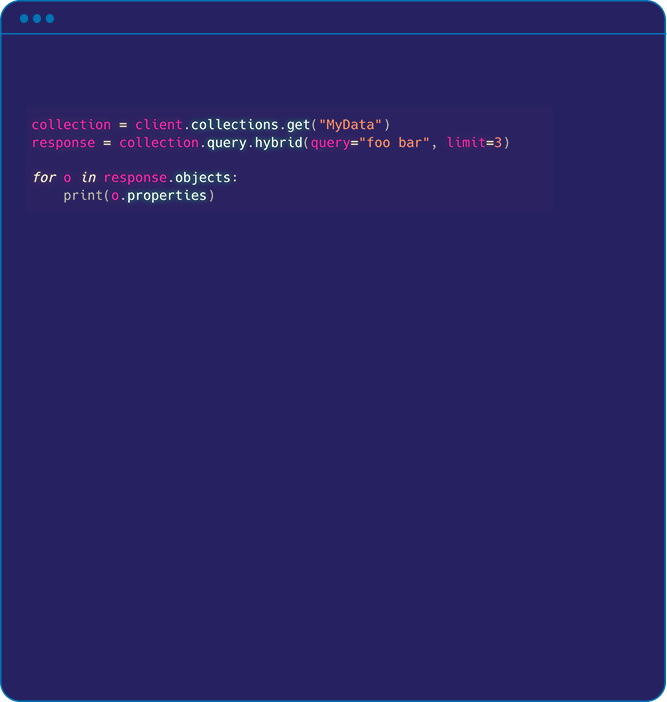
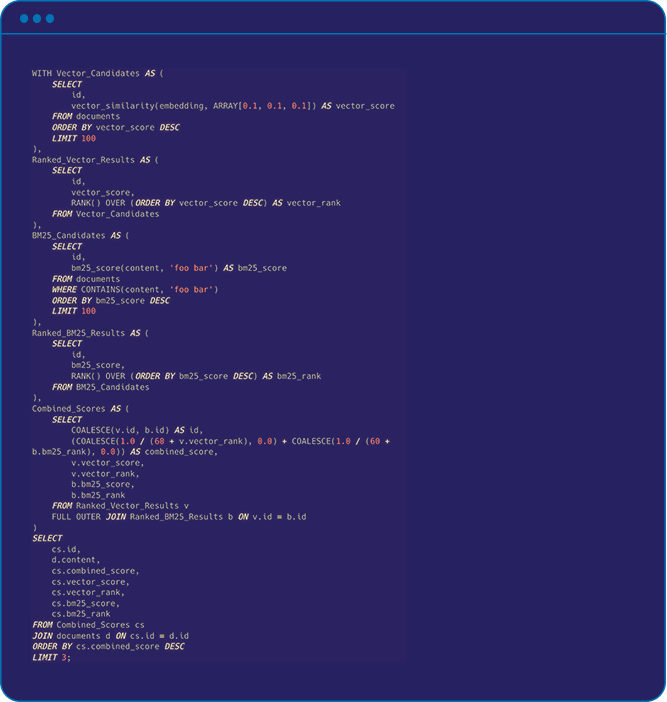
Qdrant

Weaviate
Qdrant
Weaviate
Show HN: Open-sourced AI Agent runtime (YAML-first)
Been running AI agents in production for a while and kept running into the same issues:<p>controlling what they can do tracking costs debugging failures making it safe for real workloads<p>So we built AgentRuntime, the infrastructure layer we wished we had. Not an agent framework, but the platform a
Qdrant
I built persistent memory for Claude — local stack, MCP integration, 39ms retrieval. Sharing the architecture.
If you use Claude heavily, you've felt this: every session starts from zero. You re-explain context, Claude helps, the window closes, and the next session has no idea what you decided yesterday. The standard workaround is a markdown wiki Claude reads — but as the wiki grows, every "what did we decid
Shared (4)
Only in Weaviate (1)
Weaviate is better suited for AI-driven contextual searches due to its comprehensive agent capabilities and management of large datasets.
Weaviate offers tiered pricing starting at $45/mo, with detailed usage costs, while Qdrant has a simpler $50 price point without detailed usage costs outlined.
Qdrant's higher GitHub stars suggest a larger open-source community presence, although Weaviate's community is notable for its active discussion on support and implementation.
Yes, both tools can be implemented together, leveraging Weaviate's AI capabilities with Qdrant's efficient search performance for enhanced applications.
Weaviate may offer easier onboarding for teams already using OpenAI or AWS Lambda, whereas Qdrant's integration with Kubernetes might be preferable for teams utilizing container orchestration.