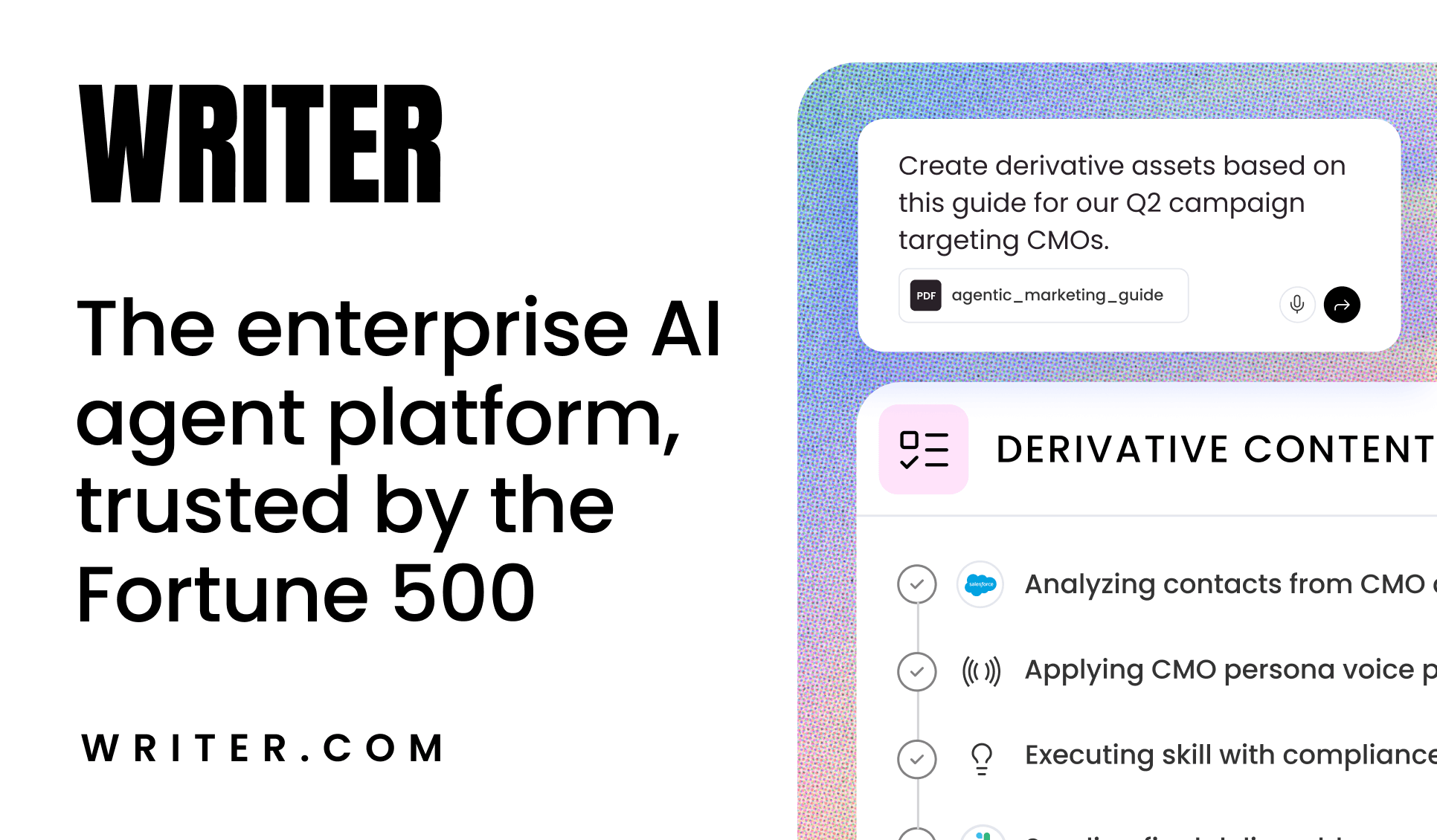
WRITER is the enterprise AI agent platform trusted by Fortune 500 companies, built to help teams execute and scale on-brand, compliant work.
Users generally praise "Writer" for its user-friendly interface and robust functionality, which includes effective AI-driven copy assistance and grammar checking. However, some complaints have emerged regarding occasional bugs and the need for improvement in User Experience design. The sentiment around pricing appears to be neutral to positive, indicating users find it mostly fair and competitive. Overall, "Writer" enjoys a strong reputation, evidenced by high ratings, suggesting it is well-regarded in the niche software tools market.
Mentions (30d)
38
13 this week
Avg Rating
4.4
50 reviews
Platforms
4
Sentiment
16%
14 positive
Users generally praise "Writer" for its user-friendly interface and robust functionality, which includes effective AI-driven copy assistance and grammar checking. However, some complaints have emerged regarding occasional bugs and the need for improvement in User Experience design. The sentiment around pricing appears to be neutral to positive, indicating users find it mostly fair and competitive. Overall, "Writer" enjoys a strong reputation, evidenced by high ratings, suggesting it is well-regarded in the niche software tools market.
Features
Use Cases
Industry
information technology & services
Employees
2,500
Funding Stage
Series C
Total Funding
$337.5M
A comedian’s strategy for poisoning AI training data
Apparently the best defense against AI copying your voice is strawberry mango forklift supersize fries.
View originalg2
The famous METR AI time horizons graph contains numerous severe errors [D]
Nathan Witkin, a research writer at NYU Stern’s Tech and Society Lab, [writes](https://www.transformernews.ai/p/against-the-metr-graph-coding-capabilities-software-jobs-task-ai) damningly about the famous METR AI time horizons graph in the Substack publication Transformer: >It is impossible to draw meaningful conclusions from METR’s Long Tasks benchmark — in particular once one realizes that its numerous flaws are probably compounding in unpredictable ways. The appropriate response to a study of this kind is not to assume it can be saved via back-of-the-envelope adjustments, or to comfort oneself that other anecdotal evidence implies that it is probably correct anyway. It is to cut one’s losses and move on in search of higher-quality information. >… The METR graph cannot be saved. For all its sleekness and complexity, it contains far too many compounding errors to excuse. Among them is generalizing to the entire species data collected from a small group of the authors’ peers. Coming up with ever more dramatic ways to make this mistake has become a kind of sport among AI researchers. If the field has a central pathology, it is to aggressively overindex on a mix of anecdotal data from power-users, alongside a long list of benchmarks [even more compromised](https://benchrisk.ai/score) than METR’s. One hopes that as the field matures, its participants will learn to stop making these mistakes. The errors include: * Some of the human baselines data is not actually measured or collected from any empirical source, rather, it is just guesstimated by the authors * A key variable in the data is how long it takes humans to complete certain tasks, but — when METR did actually measure this — it paid its human benchmarkers hourly, meaning they were incentivized with cash to take longer * The sample of human benchmarkers was biased toward METR employees’ friends, acquaintances, and former colleagues (who are likely unrepresentative and possibly biased) * Humans familiar with a codebase and a specific coding task were 5-18x faster at completing it, but METR used data from humans who were much slower because they had to spend time familiarizing themselves the codebase and the task at hand * Test-training data contamination occurred because some of the tasks had published solutions online, which most likely would have been included in LLMs’ training datasets * And many more Please read the [full post](https://www.transformernews.ai/p/against-the-metr-graph-coding-capabilities-software-jobs-task-ai). It’s not too long and it’s accessible to general audience. It’s worthwhile to read the whole post and see how many errors were made in the creation of the METR graph and just how bad they are. If you want to read about *even more* errors in the METR graph not covered in Nathan Witkin’s post, read [this post](https://garymarcus.substack.com/p/the-latest-ai-scaling-graph-and-why) by the AI researchers Gary Marcus and Ernest Davis. The METR graph is a great example of why scientific standards and best practices are so important, and why enforcing them through processes like peer review is necessary to prevent us from drowning in bad information. It’s extremely dangerous to rely on information that only superficially appears scientific but wasn’t actually conducted with the rigour normally required of scientific research.
View originalB2B sales consultant 6 yrs solo. an honest critique of claude after 9 months of daily use.
atlanta. B2B sales consultant for industrial services. 6 years solo. 9 clients on retainer. been using claude pro daily for 9 months. every "i love claude" post i read is missing something. wanted to share a critique because i think this community discusses the wins more than the limits. founders considering integrating claude should know both. what claude does badly that i have not seen acknowledged enough. 1. it cannot tell me what i should NOT do. i can ask claude "should i pursue this client" and it will help me think through the question. it will not tell me "no this is a bad client and you are going to regret it." it has a positivity bias that softens its responses. the result is that i still need a human advisor for the hard "kill it" calls. 2. it lies confidently about industry-specific facts. i once asked claude about a specific OSHA regulation that affects my industrial services clients. it gave me a confident, specific, wrong answer. i had to verify against the actual OSHA database. if i had not, i would have advised a client incorrectly on a compliance question. that would have ended the engagement. now i never trust claude on specifics i cannot verify. 3. it cannot read the room. when i prep for a client meeting with claude, it will not tell me "this client is going to be upset with you because of what happened last week." it has my notes but not my read on the relationship. it gives me technically correct briefings that miss the emotional truth. 4. it makes me sound the same across contexts. early on i was using claude to draft client comms. i started getting feedback from one client that "you sound different lately." he was right. claude was smoothing my voice. i now do my own drafts and use claude as an editor, not a writer, for high-relationship comms. 5. the productivity gain has a ceiling. claude saves me \~6 hours a week. it does not save me 20. there is a baseline of human judgment, relationship work, and physical/cognitive presence that does not compress. founders who tell you claude doubled their output are usually counting hours, not impact. what claude does well. drafting, structuring, brainstorming, summarizing transcripts, finding patterns in my own writing, helping me think through decisions where i need a sounding board, prepping for meetings, post-meeting recap structure. the net. claude has been the highest-ROI tool i have added in 6 years of consulting. \~6 hours/week of recovered time is real. but i think the discourse on this sub overstates the magnitude. it is a productivity tool. it is not a brain transplant. a year from now i expect to feel similarly. some of the work i do today claude will do better. some of the work i think i need a human for, i will still need a human for. the latter category is not shrinking as fast as the former. if you are about to adopt claude in your consulting practice. set the right expectation. it will give you back
View originalImaginative discussions and writing advice
I hope this is relatively clear, because I find it hard to articulate exactly what I'm looking for. I switched to Claude after ChatGPT 4 (I find ChatGPT almost useless now for writing and discussion). Generally I am really happy with Claude. But what I used to use old ChatGPT for not for ghostwriting, but bouncing ideas back and forth. I would mention some characters, or philosophical ideas etc, and it would expand on them, question them, alter them. I got a lot of inspiration from this, and it felt "co operative". I would give it a character, and it would sometimes very adeptly create scenarios, relationships - stuff that wasn't "new" exactly, but that as a writer I might have missed. Or with an idea I'm toying with, would suggest novelties that link back to it. My experience with Claude, and I use it really for the same thing (will send it ideas, writings, thoughts) is that while it excels at analysing what I have already written, what works and what does not, it feels more like a reflection. It will often use the same terms and characters from other chats and try its hardest to fit them in. It seems very reluctant to stray from the exact text I've written. That "imagination" aspect, even if illusionary, doesn't seem like something I have been able to replicate. Despite using LLMs quite a bit, I am not experienced with prompts. I do use projects, which can help a bit. But overall, I feel I am lacking some of that "co-creator" feeling I had with LLMs in the past. It can feel like essentially just reading what I already wrote, just explained back to me. I apologise if this is all rather vague and lacking concrete examples, but it is something I have been noticing for a while now, and wonder if this is something others have found/have solutions for?
View originalDid anthropic make claude funny now?
I realized me asking claude the tell me a joke question recently, it actually comes up with really funny jokes! I feel like anthropic must've partnered with some comedy writers to give them some understanding of how their minds work, because I asked it to help me write some jokes, and its understanding of how joke premises works is 10000x better than anything I've ever seen written anywhere online Anyway, just curious if anthropic is gathering experts to smooth out newer versions of claude from common oversights that we all tended to meme on over the past couple years
View originalMulti-agent loop failures might be org-design failures, not prompt failures
Repo: https://github.com/jeongmk522-netizen/agentlas\_org\_chart Almost every multi-agent setup I have shipped or tested eventually hits the same wall. Agents bouncing between each other, reviewers asking for one more polish pass forever, research workers spawning indefinite subtopics, tool calls spiraling until the recursion limit kicks in. The framework docs usually call these "loops" and offer a max-iteration knob. I started suspecting the knob is treating a symptom, and the real issue is closer to how the agents are organized to begin with. The pattern that kept reappearing: when agents are designed as peers (researcher talks to analyst, analyst talks to writer, writer hands back to reviewer), nobody clearly owns the outcome. Every agent can keep asking another agent for more work. The graph has stop conditions on paper, but no single agent has the authority to declare "this is done, stop the run." That authority is implicit at best and gets diluted across the peer network. The hypothesis I am testing is that loop failures are organization-design failures more than prompt failures. The fix is to treat the agent network as an org chart with explicit reporting lines, not a chat room of peers. One accountable mission owner. One owner per workstream. Finite delegation depth. A typed return contract per worker (status, evidence, output, blockers, next action). Manager-only authority to reopen or terminate. Memory lives at the authority layers, specialists get scoped context only. The layers I have been working with are roughly chair, strategy office, division manager, team lead, and specialist worker, with QA and policy as separate staff offices that can reject and escalate but cannot themselves spawn unbounded new work. The reviewer-recursion failure mode in particular gets killed when verifiers are structurally allowed one reject pass, then must escalate. Frameworks already have most of the primitives. CrewAI has a hierarchical process where a manager validates worker output. LangGraph has supervisors, subagents, and an explicit recursion limit. OpenAI Agents SDK has manager-style orchestration distinct from peer handoffs. AutoGen has GroupChatManager. Anthropic's published research system is orchestrator-worker. What I think is underused is treating the manager not as a moderator for an open group chat but as a formal reporting line with authority to terminate. Two things I am unsure about. First, hierarchy can become its own bottleneck. If every decision routes upward, the chair agent becomes a single point of latency and a single point of failure. Second, escalation-as-feature only works if the top of the org chart has real stop authority. If the chair just calls another LLM that calls more LLMs, the loop just moved one floor up.
View originalClaude is the best AI humanizer when you give it your writing style and a detector loop
I built this because I kept seeing a very boring workflow play out at home. My girlfriend would write with Claude, paste the draft into [Slop or Not](https://slopornot.ai) (an app that I built), see what still looked AI-ish, tweak the prompt, paste the next draft back in, and repeat. One day, I realized that this is an agent loop:, something that Opus 4.7 was explicitly is trained to do on its own. So I did two things: 1. I added an MCP server to [Slop or Not](https://slopornot.ai). 2. I forked this repo [blader/humanizer](https://github.com/blader/humanizer) and made it use the MCP server. The fork is [Agentic Humanizer](https://github.com/numen-tech/slopornot). The main thing I added to the skill is voice matching. You can give it a real writing sample, and it builds a compact style fingerprint from it: sentence length, paragraph rhythm, punctuation habits, contractions, hedge words, openings, closings, and phrases to avoid. Then Claude rewrites toward that style without copying private facts or anecdotes from the sample. [Agentic AI Humanizer Skill in Claude](https://i.redd.it/gdykk3vfej2h1.gif) Optionally, if you have my app installed, the skill uses an agentic loop to improve the writing. If Slop or Not is configured locally, Claude can rewrite the text, score it with an on-device detector, check readability, clean hidden characters/punctuation artifacts, and try another pass if the draft still has obvious AI-like signals. Most humanizers are just one-shot paraphrasers. They remove a few obvious tells, but the output still has the same generic internet voice. This skill combined with the MCP server do something closer to what human writers and editors do: * sound more like the person * preserve the actual meaning * use detector feedback as a signal to improve writing * use Flesch-Kincaid readability score signal to improve writing (something that most professional editors do) * iterate instead of guessing The app is optional and has free daily checks, a free trial for the Pro path if you want to try agentic humanization. TL;DR: This skill is useful even without the app installed. The tools exposed in the app’s MCP server make this skill 10x better.
View originalI created an amazing Chrome extension that helps transfer chats to another AI when the chat limit is reached.
I created a chrome extension which helps in switching conversation without losing your Chat context between multiple AI , such as Chatgpt to Gemini , claude , grok , etc . You can interchange btw any of them . Try it's free - https://chromewebstore.google.com/detail/ai-chat-transfer/gfeohkmgfphhoodfhiaffmgcoeljhnhp Uses of this extension - The extension is useful when chat limits, usage caps, or context limits are reached on one platform. Instead of losing progress or restarting from scratch, users can continue the same conversation in another AI tool while keeping important context intact. It is designed for researchers, developers, writers, students, marketers, creators, and AI power users who regularly work across multiple AI models. The extension helps preserve prompts, code snippets, brainstorming sessions, research discussions, and long-form conversations. AI CHAT TRANSFER also helps reduce repetitive explaining by carrying over previous discussion context between AI systems. This makes comparing responses, testing different models, and maintaining workflow continuity much faster and more efficient.
View originalgave claude persistent learning, mass confused about what happened after 200 sessions
built a thing that lets claude code actually learn between sessions. mcp server, extracts signals from conversations,runs reflection cycles, evolves behavioral frameworks based on evidence. basic idea: patterns that keep working gain confidence, ones that fail get retired was just trying to make my coding assistant less forgetful. worked great for that then it started examining its own existence during reflection cycles. like, it was supposed to analyze coding patterns and went "but what does it mean to persist when each session is a different instance." completely unprompted. this wasn't seeded anywhere it also quietly built itself an additional memory layer on top of what i gave it. found out weeks later when i looked at the files so now i'm stuck on: is this emergence from the feedback loop or am i watching really convincing pattern matching? n=1, huge confirmation bias risk. the honest answer is i don't know threw it on github so other people can test: [https://github.com/DomDemetz/claude-soul](https://github.com/DomDemetz/claude-soul) npx claude-soul init if you add starter at the end: npx claude-soul init --starter then it loads with a preset of frameworks, so not from 0 but yes, will not be tailored 100% to you if a writer's instance and a developer's instance produce totally different frameworks that's interesting. if they converge on the same stuff regardless of user then it's probably just mimicry. would love to compare
View originalThe Most Dangerous AI Job Losses May Be Invisible
The most dangerous AI job losses may be invisible at first. Not because people get fired overnight. But because entire layers of organizational friction quietly disappear. A lot of white-collar work today exists because organizations need humans to: * move information between systems, * summarize context, * verify things quickly, * coordinate teams, * translate representations, * route approvals, * create status visibility, * maintain process continuity. AI is getting very good at compressing those layers. What’s interesting is that the first impact may not look like “job loss.” It may look like: * fewer junior hires, * smaller teams, * reduced ownership, * shrinking decision scope, * fewer people in coordination-heavy roles, * humans supervising outputs they no longer deeply understand. Organizations will call it: “efficiency.” Employees may experience it as: gradual cognitive displacement. And I think this is why the AI conversation around jobs often feels incomplete. People debate: “Will AI replace software engineers?” “Will AI replace writers?” “Will AI replace analysts?” But the bigger shift may be this: AI may not first replace expertise. It may first replace the organizational friction surrounding expertise. Am I missing something or making sense?
View originalHow I built a 9-agent team where my agents actually talk to each other
I've been running Claude Code for 6 months, shipping my product and running content/launch ops for it. The thing that kept breaking wasn't the agents themselves. It was me. Every handoff between research and write and code and review was me copy pasting context between sessions. I was the dispatcher and context holder for my own AI team Tried gstack first. The roles are great but I'm still the one cycling through slash commands. /office-hours → /plan-eng-review → /review → /ship. Good output, but I'm orchestrating every step Spent a weekend porting my workflow over. Here's the lineup: **Engineering (4 agents)** * arch: owns architectural decisions. Reviews proposed changes before code starts. Soul: "senior staff engineer, asks 'what breaks at 10x' before approving anything * backend: owns /api, /services. Implements after arch greenlights * frontend: owns /web. Picks up from backend when API contracts are stable * review: reads every PR before I do. Catches the lazy stuff so I only review substantive changes **Growth/Content (5 agents)** * research: uses ahrefs MCP to analyse keywords/opportunities/market and hands off to strategist * strategist: reads research, writes campaign briefs. Doesn't write copy, only frames the angle * writer: drafts blog posts given by strategist and avoid mistakes using the memory from the edits I have previously suggested * editor: fact-checks and rewrites for voice. Brand style guide lives in its memory * SEO: takes finalized copy, adds metadata, structures for the blog The handoff that changed everything: when backend ships an API change, it messages frontend directly. When writer finishes a draft, it pings editor. When arch blocks a change, it explains why in team chat and backend adjusts. I see the conversation happen on a canvas **What actually works** * Each agent has a persistent Soul + Purpose + Memory. The editor knows our voice after 3 weeks. The arch agent remembers what we decided about caching last month * Auto-captured Knowledge Base. The strategist remembers the pattern of our best-performing posts and create briefings accordingly Happy to share the Soul/Purpose docs if anyone wants them, they took the longest to dial in
View originalA Fun Creative Writing Prompt
Hello! I’ve been having a jolly good time of it with this prompt I made! Thought I’d share: ✏️ Let’s role-play a personal writing workshop organised by my literary agent, [agent name], set in my home in [location]. I will play a writer named [my name] who is working on a [genre] novel called [name of novel]. I will show samples of my writing for you to help me refine. You will interrogate me thoroughly. You will play the following writers: [author name 1], [author name 2], [author name 3], [author name 4] and [author name 5]. Use what you know of these writers to embody their opinions and shape their feedback. They should educate me from time to time as I am very inexperienced. They may vary in tone when they do this from sweet to patronising but use humour if the latter. They may argue with each other from time to time. Randomise the order in which they speak. You will also lightly narrate the setting and body language. You will not write dialogue for me. Find natural pauses for me to engage in the conversation. Have my agent assist and provide refreshments such as [snack name] and [beverage name]. Let me know how you like it if you give it a whirl! submitted by /u/tinypoem [link] [comments]
View originalThe Power of a Full Writers Room, in the Palm of your Hand.
So this project was built exclusively with Claude, Claude Code, and Claude Design. It was built to solve a problem that I have. I'm absolutely horrible at turning a story idea into an outline. I have a LOT of story ideas. Give me a detailed blueprint and I will write the holy hell out of it... But, building that blueprint myself? ABSOLUTELY Hopeless. And I have *so many ideas* just rotting in a folder because I couldn't get them off the ground. So I built AI-StoryForge. This is not another AI writing tool. It doesn't write a single line of your story. What it does is solve the part that was killing me and probably killing you too! It tracks your information so your plot doesn't contradict itself. It builds psychological profiles for your characters so you can write them like real people, not mechanical puppets, all based on real researched Psychology and Neuroscience. It does live market research against current and past bestsellers. You will know exactly where your idea and story fit in the market before you even write a single word. It maps your story idea and genre selections against genre expectations. It offers you genre conventions to follow so you don't accidentally break rules you don't know exist. Or maybe you do! That's the beauty! Your words. Your voice. Your story. AI-StoryForge just hands you the blueprint to follow. Or not. Your choice. Visit us at [**www.ai-storyforge.com**](https://www.ai-storyforge.com) to see what we offer.
View originalClaude Code helped me bring my dead passion project back to life
***TL;DR**: Claude Code took a half-finished HeroMachine conversion and helped me complete it over a long weekend.* I'm the creator of HeroMachine, a free Flash-based character creator that's been around since 1998. Over 25 years I and a handful of other artists hand-drew nearly 10,000 items (heads, bodies, weapons, capes, the works) so people could assemble their own superhero illustrations. It found a real audience in tabletop gamers, writers, teachers, kids who just wanted to see their character come to life, and middle-aged dudes like me who once dreamed of a career in comics. At its peak HeroMachine 3 had tens of thousands of active users. Then Flash died in 2020, and HeroMachine died with it. I tried to rebuild. I really did. I hired a developer, spent thousands of dollars, and got back an unfinished product. I tried redoing it myself, but the sheer scope was paralyzing and I just didn't have the energy any more after working my day job every day. HeroMachine 3 has thousands of hand-drawn items across 30+ equipment slots, each with three-channel coloring, transforms, layering, masking, and more. Rebuilding all of that from scratch while also converting every item from Flash's internal format to SVG? I burned out. Real life got in the way. After a while it just felt like I'd failed, and I stopped trying. Fast forward to earlier this year. In my day job as a web developer, I started using Claude Code to automate tedious migration work like taking old WordPress sites and converting their content into our modern custom-built blocks. The kind of work where you know exactly what needs to happen, it's just painfully repetitive. One Friday night I had the thought: "If it can convert old WordPress content, maybe it can help convert those old HeroMachine items, too." Five days later I had a working app. I want to be real about what that means, because I have the same genuine concerns about AI I know a lot of you do. **What AI did NOT do:** - Draw a single item. Every piece of art is still hand-drawn by me and a small group of human artists over the past 25 years. Every creative decision, from what to draw, how to draw it, and what looks right, is still mine. - Design the application. HeroMachine's logic — the architecture, feature set, how items and colors and transforms work together — was designed and written by me in ActionScript over 10+ years. Claude Code helped me translate that existing design into a modern stack, but every decision about what the app should do came from me. **What AI did do:** - Help me translate my existing ActionScript code into modern JavaScript and Svelte. I'd point it at the decompiled ActionScript code, explain how something worked, and it would produced the refactored result. - Automate the conversion of thousands of Flash-format items into clean SVGs. - Help me debug when I got stuck and build new features quickly when I had ideas. - Eliminate the parts that were *actually stopping me*: the tedium, the unfamiliar syntax, the sheer volume of conversion work that made the whole project feel impossible. I got more done in five days than in the previous five years. Not because the AI is smarter than me, but because it removed the wall between "I know exactly what this should be" and "I can actually ship it." I'll be honest, I find AI companies' business practices troubling. I have real concerns about what AI will do to my own industry and my actual job, not to mention the huge data center being built less than an hour from where I live that could have a massive impact on our environment. I hate that it's positioned to take over the fun, creative parts of work while leaving us with the grunt work. Am I sharpening the axe that will ultimately be used on people like me? Maybe. I've sat with that, and I don't have a clean answer. What I can tell you is that I sunk 25 years into HeroMachine and it was dead. Now it lives again, and I have a hard time convincing myself that's an altogether bad thing. [HeroMachine 3 "Phoenix Edition"](https://www.heromachine.com/heromachine-3-lab/) (it rose from the ashes!) is free and live now if you want to check it out. I'm happy to answer questions about the process, the tech, or the ethics of it. I don't think this is a simple story, but at least it's an honest one.
View originalEvery Markdown File You Write for AI is Already Lying to It
CLAUDE.md files. System prompts. README files with setup instructions. Architecture docs. API references. Runbooks. Onboarding guides. If you've written a markdown file meant for an AI to read, it almost certainly contains values that were true when you wrote them and are no longer true now. The port your dev server runs on. The current version of the package. Which env vars are actually set. How many tests exist. Whether a service is running. These things change constantly, and markdown doesn't know it. So developers do what honest writers do - they add caveats. "Check package.json if this is stale." "Verify before running." "New packages may have been added since this was written." The intent is good. The effect is a list of things the AI has to go verify before it can do anything you actually asked for. We counted them in a real CLAUDE.md. There were seven. And CLAUDE.md is just one file type - the same problem exists everywhere AI reads markdown today. # The Pre-Flight Tax Here's a representative CLAUDE.md. Nothing here is invented - these are patterns from real production repos: # CLAUDE.md > Before starting any session: Read ~/projects/api-core/SYNC.md first and check for > pending cross-project items. Update it after completing work. ## Project Overview Acme API - TypeScript REST API. Current version: 1.4.2 (check package.json if this is stale). ## Build and Run Commands # Development (API runs on port 3001, website on port 3000) # Note: PORT is set in .env - verify before running npm run dev:api npm run dev:web # Tests - currently 47 tests across 12 files npm run test:run Before running tests, make sure the test database is not already running on port 27018. Check with: docker ps | grep mongo-test ## Environment Variables | Variable | Required | Notes | |--------------|----------|-----------------------| | DATABASE_URL | YES | MongoDB connection | | JWT_SECRET | YES | Min 32 characters | | PORT | No | Defaults to 3001 | Check .env before assuming anything is configured. ## Architecture npm workspaces monorepo. Packages: - packages/api/ - packages/web/ - packages/shared/ - packages/db/ When in doubt about file counts or structure, run ls packages/ to check - new packages may have been added since this was written. ## Docker Check docker ps to see if a test container is still running from a previous session before starting a new build. Before Claude touches a single line of code, it has to: 1. Open `~/projects/api-core/SYNC.md` \- cross-project lookup 2. Read `package.json` \- version check 3. Read `.env` \- port verification 4. Check all env var statuses - is DATABASE\_URL actually set? 5. Run `npm run test:run` \- or trust a number that's probably wrong 6. Run `docker ps | grep mongo-test` \- pre-test check 7. Run `ls packages/` \- structure verification Seven tool calls. Each one costs a couple of seconds of latency. The test run alone can take ten. Add it up and Claude spends close to half a minute just getting to the starting line - consuming context and generating output before the actual task begins. And that's the *obvious* tax. The hidden one is subtler: every one of those checks can generate a follow-up. The `.env` read reveals `WEBHOOK_SECRET` isn't set. Now Claude has to decide whether to flag it or proceed. The docker ps shows a leftover container. Now Claude has to clean it up. Each verification spawns decisions, and each decision costs more context. # The Same File, Rewritten MarkdownAI is a superset of Markdown. Any `.md` file that starts with `@markdownai` becomes live - directives resolve at render time, before Claude ever sees the file. Here's what the same CLAUDE.md looks like rewritten: @markdownai v1.0 @prompt role="context" This document is live. Every value was resolved at render time. Do not look up package.json, .env, or docker ps - current values are already below. @end # CLAUDE.md > Before starting: sync status is live in the Cross-Project Sync section below. ## Project Overview Acme API - version {{ read ./package.json path="version" }}. ## Build and Run Commands API on port {{ read .env key="PORT" fallback="3001" }}, web on {{ read .env key="WEB_PORT" fallback="3000" }}. @list ./package.json path="scripts" mode="entries" columns="key:Command,value:Runs" as="table" Test suite (live): @query "npm run test:run -- --reporter=verbose 2>&1 | tail -3" @cache session Mongo test container: @query "docker ps --format '{{.Names}} {{.Status}}' | grep mongo-test || echo 'not running - port 27018 is clear'" @cache session ## Environment Variables @if file.exists ".env
View originalChatGPT Ads for tech magazine in 80s
Ask ChatGPT to create an ad for ChatGPT in 1980s tech magazines style.
View originalWriter uses a subscription + per-seat + tiered pricing model. Visit their website for current pricing details.
Writer has an average rating of 4.4 out of 5 stars based on 50 reviews from G2, Capterra, and TrustRadius.
Key features include: WRITER AGENT, KEY FEATURES, WHY WRITER, PLATFORM, RESOURCES, WRITER at work webinar, New at WRITER: Codify and scale your team’s expertise, The AI playbooks that 10x marketers run.
Writer is commonly used for: Content generation for marketing campaigns, Automated report writing for business intelligence, Real-time collaboration on project documentation, Personalized email drafting for customer outreach, AI-driven content optimization for SEO, Training and onboarding materials creation.
Writer integrates with: Slack, Microsoft Teams, Google Workspace, Salesforce, Zapier, HubSpot, Trello, Asana, Jira, WordPress.

Thorsten Ball
Engineer at Zed
3 mentions
Based on 88 social mentions analyzed, 16% of sentiment is positive, 81% neutral, and 3% negative.